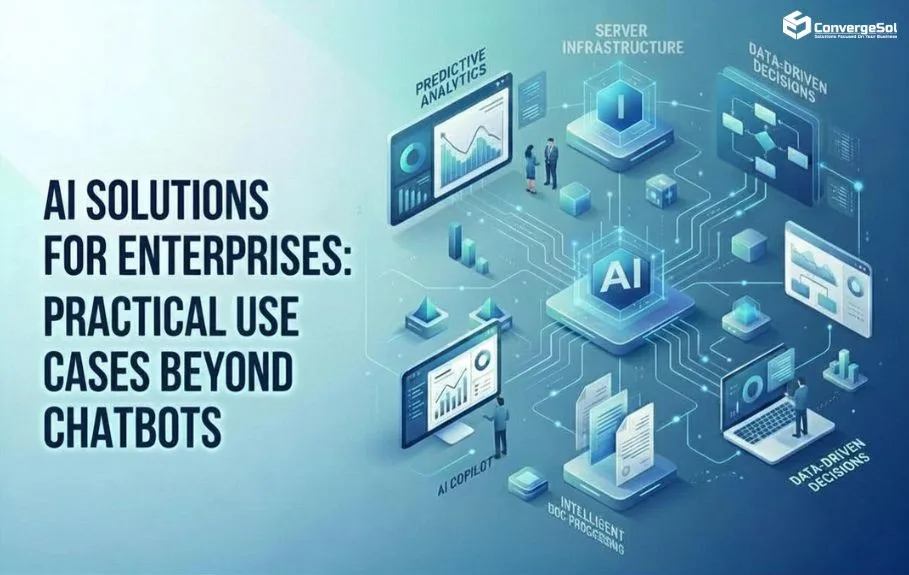
AI Solutions for Enterprises: Practical Use Cases Beyond Chatbots
Observation often starts with a question: What really changes in an enterprise when the first lines of AI code go live in production? The headline shift is clear—no more manual data entry, faster document handling, and informed predictions. Yet beneath these visible results, technology adoption creates patterns equally predictable and unexpected. I've spent years in conference rooms where AI isn’t just a buzzword, but the subject of heated debates over workflows, risk, compliance, and budgets.
Many executive teams begin their AI journey hoping for a chatbot that cuts support calls. What unfolds is usually more complex and, in most cases, more valuable. Enterprises see AI infusing workflow automation, surfacing predictive analytics, powering smart document processing, and helping employees do more than just click through forms. Through stakeholder disagreements, system integration headaches, and training challenges, I’ve witnessed a set of persistent realities—and seen certain AI solution strategies truly deliver operational efficiency.
Key Takeaways
- AI for enterprises delivers real value through workflow automation and predictive analytics, not just chatbots.
- Successful AI adoption typically confronts organizational silos, budget debates, and skill gaps.
- Examples like document processing and AI copilots often require coordinated integration across existing systems.
- Measurable operational efficiency gains are possible, but only after resolving compliance, governance, and change management hurdles.
- Tradeoffs between customization, integration complexity, and user adoption define project outcomes more than technical features do.
- Enterprise AI solutions thrive when stakeholder alignment and real-world workflow mapping precede technical rollout.
- Real returns appear not from automating simple tasks but by enabling smarter decision-making at every workflow touchpoint.
What Happens When Enterprises Go Beyond Chatbots?
Ask almost any enterprise leader about early AI projects, and they'll cite customer service chatbots. These efforts are often low-hanging fruit—quick, visible wins that ensure the CIO’s dashboard reflects progress. However, as discussions evolve, leaders see that the true impact of AI arrives when solutions go deeper, automating internal workflows, analyzing business data, and supporting staff in ways that generic chatbots can't.
I recall working with a financial services firm debating whether their AI budget should fund another customer-facing pilot or invest in predictive analytics for compliance monitoring. The compliance officers, wary from prior experiences with black-box algorithms, dug into model transparency and regulatory implications. Meanwhile, IT leaders worried about integration with legacy mainframes. These debates rarely make headlines, yet they shape project priorities far more than any vendor roadmap.
Workflow Automation: Where AI Meets Operational Reality
The appeal of workflow automation is undeniable—faster decisions, accurate handoffs, fewer human errors. But for enterprises, automating business processes with AI doesn’t mean simply dropping algorithms into existing tools. It demands the mapping of real-world process flows, identifying friction points, and dealing with bottlenecks known only to front-line staff.
In my experience, the hardest part isn’t coding the automation, but getting a consensus on which workflow steps really matter. Teams may disagree: Operations managers see value in automating exception handling; compliance teams demand manual review for sensitive decisions; finance asks about auditing and cost controls. Each stakeholder brings their own risk lens, shaping what gets prioritized.
Adoption rates hinge on these negotiations. In one enterprise roll-out, AI automated invoice matching and approvals, reducing turnaround from days to hours. But the gains didn’t surface until roles, escalation paths, and review checkpoints were clearly established—and until executive sponsors made adoption a performance metric.
For organizations looking to modernize workflow automation, it’s not just about algorithms. It’s about bridging organizational divides and translating business logic into automation rules that AI can reliably execute and explain.
For more on effective SaaS workflow automation tactics, see Best Practices for Building Multi-Tenant SaaS Platforms with .NET and Angular.
Predictive Analytics: Decision-Making Powered by AI
Most predictive analytics pilots start with one ambitious goal: anticipating outcomes. In practice, the journey is shaped by mundane—but essential—considerations. Where does the data come from? How clean is it? Who “owns” the model’s outputs, and what happens if predictions are wrong?
I observed a SaaS product development team wrestle with these questions. The CEO wanted AI-powered forecasting to guide roadmapping. Product owners, however, argued over which historical data truly reflected customer demand, while engineers cautioned that missing data would skew results. Behind closed doors, heated debates over analytics governance governed what the model delivered and when the findings hit the next executive call.
Predictive analytics for finance, sales, or even IT resource planning can yield transformational results. However, the operational payoff only arrives when organizations confront uncomfortable realities: How are predictive insights incorporated into decision workflows? How are mistakes communicated and remediated? Who signs off on the risk thresholds?
For a detailed exploration of predictive analytics in fintech, see Modern FinTech Software Development with .NET Core and Microservices Architecture.
Across verticals, predictive analytics unlocks smarter resource allocation and risk mitigation—provided the business confronts bad data, aligns on KPIs, and adapts governance policies for AI-driven recommendations.
See also Microsoft’s guidance on automated machine learning in enterprise settings.
AI Copilots and Intelligent Document Processing: The Next Layer
AI copilots—interactive assistants that help knowledge workers complete tasks—are gaining traction across business units. Unlike basic chatbots, these systems navigate enterprise data, generate draft reports, or highlight regulatory risks in real time. Their promise is not just automation, but augmented decision-making.
Yet, deploying copilot-like features reveals organizational limits. Document processing is a telling example. Many healthcare and insurance companies I’ve observed tried to automate claim intake using off-the-shelf AI models. Early pilots often misread handwritten forms or flagged ambiguous cases, resulting in manual backlogs and frustrated staff. Success only emerged after teams invested in domain-specific data labeling and set up fallback processes—where human reviewers could seamlessly take over.
Here, the lesson is clear: AI can dramatically cut costs and processing times—but only when workflows explicitly account for the limitations of automation. When AI knows when to step aside and let human judgment rule, both accuracy and user trust climb.
Learn about adopting standout AI copilots and optimizing document workflows at AI Solutions for Enterprises.
For more practical insights on enterprise AI use cases, the strategic framework for building AI-driven enterprise applications explores alignment with business goals.
Operational Efficiency and the Organizational Tangle
Talk of AI-fueled operational efficiency often glosses over how tangled real enterprise environments are. Most organizations maintain sprawling portfolios—custom software stitched to SaaS, with process glue provided by manual workarounds. Introducing AI is less a surgical insertion and more a complex graft requiring consensus, resourcing, and phased rollouts.
Budget constraints, for example, frequently stall promising pilots. I’ve sat in finance committee meetings where leaders weigh immediate ROI against longer-term automation potential. "Can we measure the savings by next quarter?" is a familiar refrain. Compliance teams zero in on audit trails and explainability—especially for document processing and predictive models used in regulated industries.
And while the appeal of AI copilots is strong, deployment often hinges on solving enterprise integration. For example, connecting a copilot to CRM and ERP systems means untangling legacy frameworks that few current employees fully understand. This creates delays—sometimes for months—as IT uncovers hidden dependencies.
Operational efficiency from AI, then, isn’t just a product of smart algorithms. It’s the outcome of coordinated agreement across siloed teams, investments in data readiness, and realistic performance management.
For organizations prioritizing scalable operational efficiency, Application Management Solutions and Cloud Solutions can offer actionable starting points.
Navigating Implementation: Lessons Learned from the Field
If there’s one pattern I’ve repeatedly observed, it’s that the toughest AI challenges aren’t technical—they’re organizational. Early optimism tends to collide with entrenched workflows and unclear ownership. Change management becomes as mission critical as testing the AI’s algorithmic performance.
Skill shortages frequently come to the fore. Many teams underestimate the demand for AI-fluent business analysts and the need for staff retraining. Early adopters who invest in upskilling tend to report higher, more sustained productivity boosts than those who treat AI as simply another IT project.
The more successful enterprises cultivate executive sponsors willing to shield cross-functional AI teams from “scope creep” and shifting priorities. They pilot projects in bounded areas—invoice processing, compliance reviews, or sales forecasting—before scaling solutions across business units. Crucially, they set realistic expectations, knowing that some legacy integrations will lag and that AI adoption is a gradual, iterative process.
For those navigating enterprise AI transformation, a strategic, iterative mindset matters far more than quick wins.
To explore the full innovation journey, visit Product Development Solutions and Low Code Development Solutions for adaptable implementation pathways.
Further, for compliance-driven sectors, the NIST AI Risk Management Framework offers essential guidance on trustworthy and effective AI integration.
Frequently Asked Questions
How is workflow automation different when AI is involved?
Traditional workflow automation codifies set rules and triggers. AI-driven automation, on the other hand, learns from enterprise data, adapts to new conditions, and supports decision points that can’t be defined in advance. This often means the biggest challenge is mapping real, lived business processes into logic AI systems can handle, while ensuring oversight for exceptions.
What should enterprises know about AI predictive analytics before adoption?
Successful predictive analytics depend on data quality, executive alignment, and attention to output governance. Many pilots falter due to disputes about which data sets represent true business realities, or because risk owners demand clarity on how predictions are used in daily decisions. Auditability and the willingness to adapt business policy are critical for operationalizing AI-driven forecasts.
How do AI copilots differ from basic chatbots in the enterprise?
AI copilots transcend basic Q&A and can actively assist with document generation, search internal knowledge bases, and highlight business risks. Unlike chatbots that automate simple responses, copilots require deeper system integration and rigorous oversight. Their success often hinges on employee trust and their ability to handle edge cases gracefully.
What are common obstacles to scaling AI solutions in large organizations?
Some of the most persistent obstacles are budget allocation disputes, skills shortages, and the integration of AI with legacy applications. Additionally, compliance reviews and change management often delay rollout. Without a coordinated approach, efforts risk stalling in the pilot phase.
How do organizations measure the operational efficiency gains from AI?
Enterprises typically track time-to-completion for key workflows, reduction in manual errors, and increases in throughput. But measuring efficiency requires joint input from finance, operations, and IT, along with new KPIs that capture both quantitative savings and qualitative improvements—such as employee satisfaction or customer experience enhancements.
AI adoption in the enterprise rarely proceeds in a straight line. Even with robust technical capabilities, the deciding factor often lies in the organization’s willingness to realign processes, build new skills, and adapt policies. The path from chatbot pilot to full-scale workflow automation and predictive analytics is riddled with lessons, tradeoffs, and—when successful—hard-won efficiency gains.
For more practical guidance on launching scalable, resilient AI solutions, explore top SaaS product development challenges and solutions. For human-centered digital transformation, review enterprise AI hiring strategies tailored to your business context.
Technology is only as transformative as the practices and agreements built around it. Enterprises that recognize this—balancing algorithmic promise with operational realties—will be best positioned not just for the next wave of AI hype, but for everyday business results.
Based in the US and exploring enterprise AI solutions?
Connect with our team to discuss your AI initiatives and explore practical solutions that can deliver measurable business outcomes. Talk to our team
Write your comment
Recent Blogs