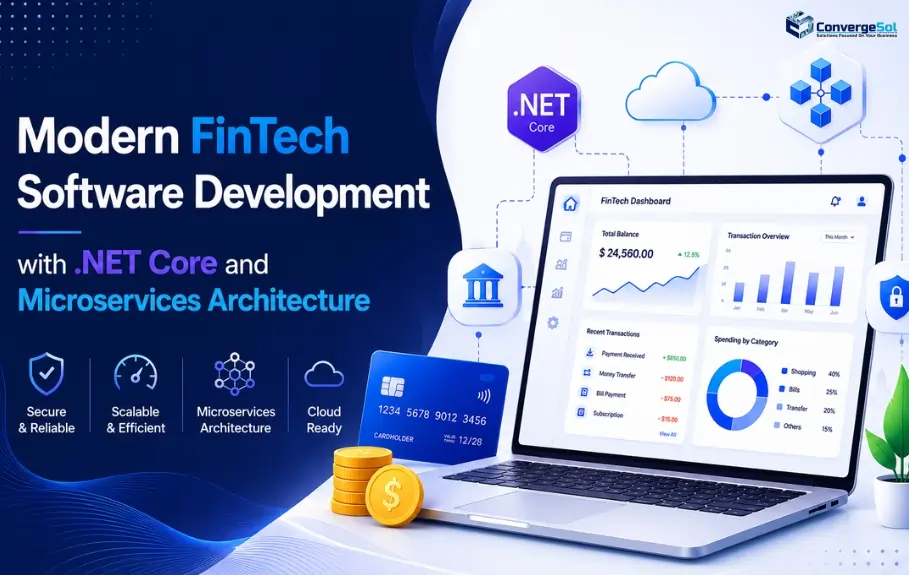
Modern FinTech Software Development with .NET Core and Microservices Architecture
The financial services industry is undergoing an unprecedented digital transformation. The shift from traditional banking models to agile, digital-first financial technology has created a massive demand for robust, high-performance software solutions. Today's consumers and businesses expect financial applications to be lightning-fast, available 24/7, and impenetrably secure.
Achieving this requires moving away from legacy monolithic architectures and embracing modern paradigms. This is where the synergy between .NET Core and microservices architecture becomes paramount. By leveraging these advanced technologies, companies are redefining Fintech Software Development to build systems that handle massive scale without compromising on performance or security.
In this comprehensive guide, we will explore the core pillars of modern FinTech architecture: scalability, compliance, API-first design, secure transactions, and event-driven systems. We will uncover how .NET Core acts as the ideal framework to bring these microservices to life, ensuring that your financial products are built for the future.
Key Takeaways
- .NET Core enables secure, high-performance, and cloud-native FinTech application development.
- Microservices architecture improves scalability, resilience, and deployment flexibility.
- API-first design simplifies integration with banks, payment gateways, and third-party financial services.
- Event-driven architecture supports real-time transaction processing and system responsiveness.
- Kubernetes helps automate deployment, scaling, and management of FinTech microservices.
- AI-powered solutions enhance fraud detection, risk assessment, compliance monitoring, and customer experiences.
- Combining .NET Core and microservices creates future-ready FinTech platforms that can adapt to evolving business and regulatory requirements.
The Legacy Monolith vs. The Microservices Revolution
Historically, financial applications were built as massive monoliths. In a monolith, the user interface, business logic, data access layers, and third-party integrations are tightly coupled into a single, unified codebase. While this approach worked for initial deployments decades ago, it quickly became a bottleneck in the modern era.
In a monolith, a simple update to a payment gateway could risk bringing down the entire banking portal. Deployment cycles take weeks or months, and scaling requires duplicating the entire massive application, resulting in wasted server resources.
Microservices architecture solves this by breaking down the application into small, independent services that communicate over well-defined APIs. Each service is responsible for a specific business capability—such as user authentication, transaction processing, account management, or fraud detection.
This decentralization is a critical foundation for enterprise-grade Custom Software Development. It allows development teams to work autonomously, deploying updates to individual services without impacting the broader system. For FinTech, this means faster time-to-market for new features, superior fault isolation, and the ability to scale specific components dynamically based on demand. Using Domain-Driven Design (DDD), bounded contexts are established to ensure services remain loosely coupled and highly cohesive.
Why .NET Core is the Definitive Choice for Financial Systems
.NET Core (and its unified successor, .NET 8 and beyond) has emerged as a dominant force in enterprise application development. Microsoft engineered the modern .NET ecosystem to be cross-platform, high-performance, and cloud-native—perfectly aligning with the stringent needs of modern FinTech.
- Unmatched Performance: .NET Core consistently ranks among the fastest web frameworks in global benchmark tests. Technologies like the Kestrel web server handle millions of requests per second. High throughput and ultra-low latency are non-negotiable in financial trading platforms, where milliseconds dictate profit or loss.
- Cross-Platform Flexibility: Gone are the days when .NET meant being locked into Windows Servers. Modern .NET runs seamlessly on Linux, macOS, and Windows. This flexibility is crucial for hybrid cloud strategies often employed by large financial institutions.
- Minimal APIs and gRPC: .NET allows developers to build lightweight, high-performance HTTP APIs. Furthermore, built-in support for gRPC enables blazing-fast, binary-serialized communication between internal microservices, drastically reducing network overhead compared to traditional REST.
- Rich Ecosystem: The .NET ecosystem offers mature, enterprise-grade libraries for cryptography, secure data access via Entity Framework Core, and identity management, significantly accelerating development timelines.
Pillar 1: Architecting for Unmatched Scalability
Scalability is the lifeblood of any growing financial platform. A system might process thousands of transactions per second during a flash crash, a major retail event, or payroll day. If the architecture cannot scale dynamically, the system will fail, resulting in lost revenue and shattered consumer trust.
As highlighted in our technical deep dive on why most systems break at scale and how .NET actually helps, scaling is not just about throwing more RAM at a server; it is about architectural resilience.
Microservices allow for true horizontal scaling. If the payment processing service is experiencing heavy load, you can spin up additional instances of just that specific service, rather than scaling the entire application.
When developing a massive SaaS Product Development platform for the financial sector, orchestrating these microservices with Kubernetes is the industry standard. Kubernetes ensures automated scaling (via Horizontal Pod Autoscaling), load balancing, and self-healing. .NET Core's lightweight footprint makes it ideal for Docker containerization, allowing instances to boot up in milliseconds to instantly handle unexpected traffic spikes.
Furthermore, stateless service design ensures that user sessions are maintained via distributed caches like Redis, allowing any service instance to handle any request seamlessly.
Pillar 2: Ironclad Security and Stringent Compliance
In FinTech, security is not an optional feature; it is the absolute foundation of the business. Applications handle highly sensitive PII (Personally Identifiable Information) and financial records, making them prime targets for sophisticated cyberattacks.
- Zero Trust Architecture: In a microservices environment, security must be enforced everywhere, not just at the network perimeter. Mutual TLS (mTLS) is used to encrypt service-to-service communication, ensuring that even if the internal network is breached, data remains unreadable.
- Identity and Access Management (IAM): Implementing OAuth 2.0 and OpenID Connect (OIDC) ensures robust, token-based authentication. .NET Core integrates seamlessly with identity providers like Azure Active Directory, IdentityServer, and Auth0.
- Data Protection and Encryption: Sensitive data must be encrypted both in transit and at rest. .NET Core's built-in cryptographic providers make it straightforward to implement AES-256 encryption, secure hashing algorithms for passwords (like Argon2), and seamless integration with Azure Key Vault or AWS KMS for managing cryptographic keys.
- Data Masking and Anonymization: For logs and analytics, sensitive data must be masked to prevent accidental exposure of credit card numbers or social security numbers.
Compliance is equally critical. Whether adhering to PCI-DSS for payment card data, GDPR for European user data, or SOC 2 for overall organizational security practices, the software must be rigorously auditable. Microservices assist by isolating in-scope data. For example, by keeping all credit card processing within a single, highly secured service boundary, you drastically reduce the compliance audit scope for the rest of the application ecosystem.
Pillar 3: Embracing an API-First Architecture
Modern FinTech thrives on connectivity. Consumers expect their banking apps to integrate natively with budgeting tools, investment platforms, and third-party payment gateways. This expansive ecosystem is powered entirely by APIs.
An API-first architecture means that APIs are treated as first-class citizens. They are designed, mocked, and documented before any underlying business logic is written. This approach ensures consistent contracts between backend services and external consumers.
- Open Banking Integration: Regulatory shifts, such as PSD2 in Europe, mandate that banks open their financial data to authorized third parties securely. Robust APIs built with ASP.NET Core Web API make these integrations seamless, secure, and highly performant.
- Banking as a Service (BaaS): FinTechs are increasingly offering white-label banking services. An API-centric design allows partners to embed financial services—like issuing virtual cards or processing loans—directly into their own non-financial products.
- Developer Experience (DX): Using tools like Swagger (OpenAPI specification) natively with .NET Core ensures that APIs are highly discoverable, well-documented, and easy for third-party developers to consume. This fosters a collaborative financial ecosystem and speeds up partner integrations.
Pillar 4: Event-Driven Systems for Real-Time Processing
Traditional synchronous request-response models fall short in complex financial workflows. For instance, when a user transfers funds, multiple discrete actions must occur: validating the balance, deducting the funds, crediting the recipient, notifying both users via push notifications, checking against AML (Anti-Money Laundering) watchlists, and logging the immutable audit trail. Doing this synchronously would result in unacceptable latency and single points of failure.
Event-driven architecture (EDA) elegantly decouples these processes. When an action occurs, the originating service publishes an "event" to a message broker (such as Apache Kafka, Azure Service Bus, or RabbitMQ). Other microservices subscribe to these events and process their respective tasks asynchronously in the background.
- Event Sourcing: Instead of just updating and storing the current state of an account in a database, Event Sourcing involves storing a sequence of state-changing events (e.g., "Deposited $50", "Withdrew $20"). This provides a cryptographically verifiable, immutable audit log, which is invaluable for financial reconciliation and regulatory compliance.
- CQRS (Command Query Responsibility Segregation): In high-traffic systems, reading data and writing data have vastly different scaling requirements. Separating the read and write operations improves performance and security. .NET Core is exceptionally well-suited for implementing the CQRS pattern alongside event sourcing.
- Handling Distributed Transactions: Microservices face the immense challenge of maintaining ACID data properties across separate, isolated databases. The Saga pattern, implemented via message brokers, ensures data consistency across services by coordinating local transactions and executing automated compensating actions (rollbacks) if any step in the process fails.
Beyond the Core: Integrating AI and CRM
While massively scalable, event-driven back-end systems process the transactions, modern FinTechs must also excel at customer engagement, personalization, and proactive risk management. This is where advanced external integrations come into play.
Leveraging cutting-edge AI Solutions for Enterprises allows financial institutions to analyze vast amounts of transactional data in real time. Machine learning models can detect anomalous behavior indicative of fraud within milliseconds, assess credit risk dynamically using alternative data points, and power algorithmic trading bots. As a leading AI Solution Provider, Converge Solution integrates these intelligent capabilities directly into the microservices ecosystem, ensuring AI operates seamlessly at the edge of the financial network.
Furthermore, seamless customer relationship management is crucial for retention. By integrating backend financial data with top-tier CRM platforms, companies can provide hyper-personalized experiences. Our Salesforce Consulting Services ensure that customer-facing teams and financial advisors have a complete, 360-degree view of the client’s financial portfolio. This enables proactive support, automated onboarding workflows, and highly targeted product offerings.
Frequently Asked Questions
Q1. What is microservices architecture in FinTech software development?
Microservices architecture divides a FinTech application into smaller independent services such as payments, authentication, fraud detection, and account management. This approach improves scalability, reliability, and deployment speed while reducing the risk of system-wide failures.
Q2. Why is .NET Core a good choice for FinTech applications?
.NET Core offers high performance, strong security features, cross-platform compatibility, cloud-native capabilities, and support for APIs and microservices, making it ideal for modern financial software development.
Q3. How do microservices improve scalability in FinTech platforms?
Microservices allow individual services to scale independently. For example, payment processing services can be scaled during peak transaction periods without increasing resources for the entire application.
Q4. What security measures are essential for FinTech software?
Key security measures include encryption, OAuth 2.0 authentication, OpenID Connect, multi-factor authentication, Zero Trust Architecture, secure API gateways, and compliance with regulations such as PCI-DSS and GDPR.
Q5. What is an API-first approach in FinTech development?
An API-first approach prioritizes designing and documenting APIs before building application functionality. This enables easier integration with banking systems, payment gateways, open banking platforms, and third-party financial services.
Q6. How does event-driven architecture benefit financial applications?
Event-driven architecture enables real-time processing by allowing services to communicate asynchronously through events. This improves system responsiveness, reliability, and transaction processing efficiency.
Q7. What role does Kubernetes play in FinTech microservices?
Kubernetes automates deployment, scaling, load balancing, and recovery of microservices. It helps FinTech applications maintain high availability and handle traffic spikes efficiently.
Q8. How can AI enhance modern FinTech software platforms?
AI helps FinTech companies detect fraud, automate risk assessment, personalize customer experiences, improve compliance monitoring, and analyze large volumes of financial data in real time.
Conclusion: Future-Proofing Financial Technology
Building modern FinTech software is an incredibly complex undertaking that requires navigating deep technical, regulatory, and business challenges simultaneously. Legacy monoliths are no longer sufficient to meet the exponential demands of real-time processing, global scale, and continuous integration.
By adopting .NET Core and a microservices architecture, organizations lay a robust, agile, and fiercely secure foundation. This architectural approach guarantees unparalleled horizontal scalability, strict adherence to global compliance standards, seamless third-party API connectivity, and the immense processing power of event-driven asynchronous workflows.
At Converge Solution, we specialize in engineering these next-generation financial platforms from the ground up. Whether you are launching a disruptive SaaS product, migrating a monolithic legacy bank to the cloud, or integrating enterprise AI to supercharge your risk operations, our deep domain expertise ensures your software is built to perform and designed to scale indefinitely.
Ready to modernize your financial infrastructure? Explore our comprehensive development services today and discover how we can transform your FinTech vision into an enterprise-ready reality.
Write your comment
Recent Blogs