Best Practices for Building Multi-Tenant SaaS Platforms with .NET and Angular
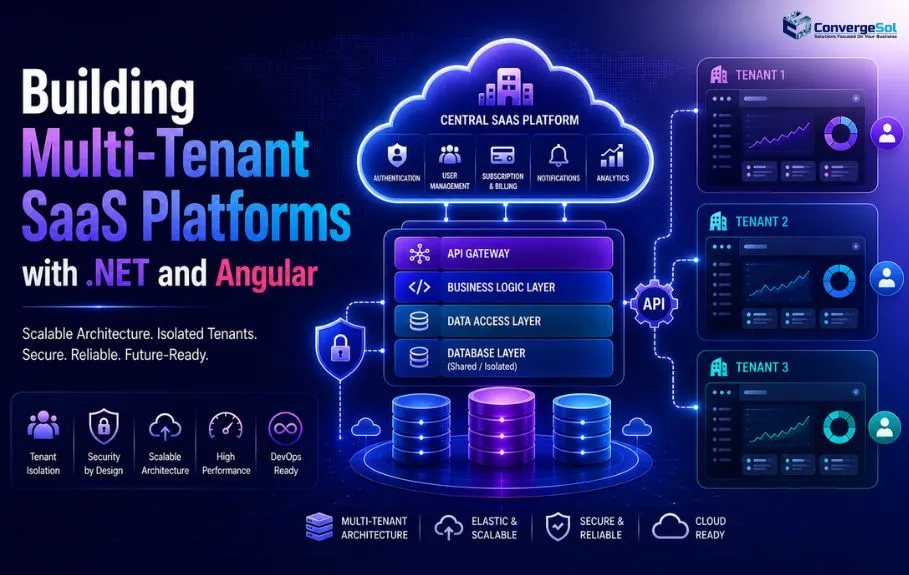
As digital transformation accelerates across industries, the multi-tenant Software-as-a-Service (SaaS) model is not just a technical trend—it is a decisive lever for business agility, profitability, and competitive differentiation. According to Gartner, over 90% of new SaaS apps are architected as multi-tenant solutions to maximize ROI and operational scalability.[1] For technology executives and business leaders, the adoption of multi-tenant SaaS platforms is pivotal to delivering modern, resilient, and customer-centric digital experiences while keeping costs and risks in check. Leveraging industry-leading frameworks like .NET and Angular, organizations can architect platforms that drive both technological and strategic advantages across the enterprise value chain.
Yet, the journey to high-performing, scalable SaaS is rife with business and technical trade-offs—particularly around tenant isolation, compliance, authentication, architecture, and scaling. Without an executive-aligned strategy and best practices, SaaS modernization efforts can result in security breaches, downtime, runaway costs, or lagging innovation.
This executive guide targets product owners, technology strategists, and SaaS architects navigating mission-critical transformation. We present key architectural concepts, real-world case insights, and practical recommendations for building secure, future-ready multi-tenant SaaS platforms with .NET and Angular. The discussion highlights business and regulatory implications, scaling strategies, and emerging trends—from AI-powered SaaS to global data governance—and concludes with clear actions for executive leadership.
Key Takeaways
- Understand core multi-tenancy models and how .NET and Angular support them
- Adopt effective tenant isolation techniques to maintain security and data privacy
- Choose the right database strategies for manageability and performance
- Implement robust authentication and authorization frameworks
- Scale applications efficiently with proven architectural patterns
- Leverage monitoring tools to proactively address issues and optimize performance
- Integrate best practices with cloud-native, DevOps, and automation approaches
Understanding Multi-Tenancy in SaaS
Multi-tenancy enables a single software instance to serve multiple customers—known as tenants—while keeping data, configuration, and resources logically or physically isolated according to business needs. With .NET at the backend and Angular at the frontend, organizations can deliver dynamic, performant, and maintainable multi-tenant applications that support rapid expansion and customization.
The significance of the right multi-tenancy model becomes clear when considering business outcomes. For example, Salesforce’s success in onboarding thousands of enterprises on a shared infrastructure—while ensuring compliance, customization, and uptime—demonstrates that the model directly correlates with enterprise scalability and cost efficiency.[2]
Common approaches to multi-tenancy include:
- Shared Database, Shared Schema: All tenants use the same database and schema, distinguished by a TenantID column. This model allows economical scaling for SaaS vendors serving thousands of small-to-mid-sized clients, but demands robust logical separation and vigilant controls to avoid costly data leaks or compliance violations.
- Shared Database, Separate Schema: Each tenant is provisioned with a unique schema within a shared database, providing stronger isolation—ideal for organizations navigating regional data residency requirements or handling sector-specific compliance such as HIPAA or GDPR.
- Separate Database per Tenant: Each tenant receives a dedicated database, maximizing isolation and performance for large enterprise or highly regulated industries, but at an increased operational complexity and cost.
Executives must weigh considerations such as regulatory environment, scaling requirements, and support burden when selecting a database strategy. For a deeper dive on business-led SaaS development, read our SaaS challenges overview.
Understanding these tenancy models empowers leaders to make informed trade-offs between cost, risk, flexibility, and compliance—positioning their SaaS offering for sustainable growth and global scale.
Tenant Isolation: Why It’s Critical and How to Achieve It
Tenant isolation is not merely a technical safeguard—it is the linchpin for customer trust, brand reputation, and regulatory compliance in multi-tenant SaaS. Executives need to consider headline-making incidents, such as the 2022 cloud breach at a leading CRM SaaS vendor, where inadequate tenant isolation led to costly cross-tenant data exposures and triggered a wave of client churn and legal repercussions.[3]
To mitigate such risks, robust tenant isolation strategies are essential for aligning with SOC 2, GDPR, and sector-specific mandates.
- Logical Isolation: Application-layer safeguards enforce strict resource boundaries. Custom authorization middleware in .NET—backed by multi-tenancy-aware context and service injection—ensures every API call, query, and transaction is tenant-sensitive.
- Physical/Data Isolation: For industries like finance or healthcare with stringent compliance expectations, separate database schemas or dedicated databases per tenant may be required. Entity Framework enables seamless dynamic connection switching based on tenant context.
- Angular Tenant Routing: Angular’s route guards and state management techniques ensure only tenant-specific data and navigation options appear at the frontend, protecting against both accidental and malicious cross-tenant exposure.
Studies indicate that over 50% of SaaS security incidents result from insufficient isolation controls.[4] For most SaaS businesses, a hybrid of logical isolation and targeted physical separation—augmented by fine-grained Role-Based Access Control (RBAC)—delivers optimal business agility and compliance.
For more on how modern platforms empower tenant isolation and business control, see ConvergeSol’s product development solutions.
With these controls in place, executive teams can assure clients, regulators, and investors that tenant privacy and security are embedded by design—not deployed as an afterthought.
Database Strategies for Multi-Tenant SaaS
The foundation of every multi-tenant SaaS solution is its database architecture. Strategic decisions made at this layer impact not just cost and performance, but market flexibility and compliance posture over years of operation. The .NET ecosystem offers robust connectivity to Microsoft SQL Server, Azure SQL, Postgres, and other platforms supporting the full range of tenancy models.
As organizations grow, SaaS leaders must consider both current needs and future scale. For instance, Slack famously migrated from a shared schema to a sharded per-tenant architecture to accommodate exponential user growth, reducing the risk of noisy neighbor issues and downtime.[5]
Key considerations for robust SaaS database strategy:
- Performance Optimization: Segregating high-volume tenants into dedicated databases or schemas can guarantee SLAs and reduce cross-tenant performance drift. Shared models require advanced indexing and intelligent caching.
- Automated Provisioning: Executives should champion investments in infrastructure automation; templated schema provisioning enables seamless self-service onboarding at scale, reducing support costs.
- Security: Encryption in transit and at rest is now a baseline. Managed services like Azure SQL further offload operational risk for patching, failover, and backup.
- Scalability: Anticipate global expansion and surges in tenant data by planning for sharding strategies and seamless partition management.
For practical guidance on designing multitenant solutions and selecting appropriate tenancy models, consult Microsoft’s Architect multitenant solutions on Azure.
See how ConvergeSol’s data solutions deliver secure, elastic foundations for SaaS at enterprise scale.
The right database strategy is a board-level concern—with direct impact on cost per tenant, market reach, and compliance exposure.
Authentication and Authorization in Multi-Tenant Platforms
Secure, seamless user authentication is non-negotiable as SaaS platforms serve ever-larger client portfolios and support Bring Your Own Identity (BYOI). In fact, a Forrester report notes that 40% of SaaS breaches in 2023 involved compromised or misconfigured access controls.[6]
With .NET, platforms can integrate best-in-class identity providers (Azure AD, Auth0, Okta) for federated and multi-factor authentication—enabling tenants to use their credentials securely.
- Multi-Tenant Authentication: Personalize login portals and IdP routing based on tenant context—supporting SSO, branding, and custom flows to bolster client trust.
- Token-Based Security: Leverage JWT and OAuth 2.0 to propagate tenant, user, and permission claims directly with each request, reducing risk of privilege escalation or session hijacking.
- Angular Guards: On the frontend, Angular’s route guards and lazy-loading modules restrict data exposure, preventing privilege creep as tenants and users evolve.
The stakes are high: a misstep in these flows can trigger public trust crises and regulatory penalties. The OWASP Top Ten provides executive-level context into leading cloud risks.
Explore how AI-driven solutions can proactively surface and mitigate identity threats in real time—a growing imperative as regulatory complexity and threat sophistication rise.
Scaling Your Multi-Tenant SaaS Platform
SaaS market leaders are defined by their ability to offer effortless scaling—delivering a reliable user experience during both steady growth and rapid spikes, without spiraling costs. Research by IDC confirms that organizations with automated scaling report 40% lower operational overhead and up to 28% faster revenue growth.[7]
Transitioning from technical considerations to business impact, strategic scaling ensures enterprise clients never experience resource contention, degraded performance, or outages during critical workflows.
- Stateless Application Design: Stateless APIs—powered by distributed caches like Redis with .NET—allow horizontal scaling across commodity infrastructure, reducing cloud spend per user.
- Containerization & Microservices: By leveraging Docker and Kubernetes, organizations can independently scale workloads, apply blue-green deployments, and minimize downtime—critical for landing enterprise contracts with strict SLAs.
- Auto-Scaling: Managed services such as Azure App Services and AWS ECS enable dynamic, pay-as-you-go scaling, subsequent to real-time user demand patterns.
Learn how .NET 10’s architecture powers at-scale SaaS in our practitioner’s guide to .NET scaling.
For enterprise-ready solutions that streamline your cloud journey, explore our managed cloud services.
By instilling these patterns, executives turn scaling into a true business accelerant—enabling rapid market expansion and customer acquisition, while preserving uptime and client satisfaction.
Real-World Example:
ConvergeSol developed a SaaS-based vacation rental platform using .NET Core and Angular that supports secure user authentication, advanced search capabilities, third-party integrations, and a scalable cloud architecture. This project demonstrates how ConvergeSol applied scalable SaaS architecture, secure authentication, and cloud-native engineering practices to build a high-performance platform capable of supporting business growth and an exceptional user experience. Explore the complete SaaS-based Vacay Rental Platform case study.
Monitoring, Logging, and Performance Optimization
Visibility is the executive’s hedge against risk in a multi-tenant environment. Comprehensive monitoring and analytics underpin not only performance, but compliance reporting, SLA enforcement, and proactive remediation.
Consider the costs of poor observability: in a recent KPMG survey, 60% of SaaS leaders cited lost revenue and customer churn from undetected outages or slowdowns.[8] Executives must sponsor investments in unified monitoring that provides actionable, tenant-level insights.
- Centralized Logging: Aggregate platform-wide logs using Serilog and integrate with sophisticated dashboards (ELK, Azure Monitor) to enable rapid root-cause analysis—essential for major incident handling and regulatory audit trails.
- Real-Time Monitoring: Deploy tools like Application Insights and Prometheus for fine-grained telemetry on tenant usage, API performance, and SLA adherence.
- Proactive Alerts: Automate anomaly detection and trigger escalation workflows—avoiding manual firefighting and reputational damage.
- User Experience Analytics: Use Angular plugins to track UI errors, navigation failures, and bottlenecks—enabling data-driven product decisions and differentiated customer experience.
For guidance on monitoring and managing the operational health of multi-tenant SaaS environments, review AWS SaaS Lens – Operate
To see AI-powered analytics and anomaly detection in action, read about enterprise AI innovation.
Proper instrumentation does not just reduce downtime—it protects revenue, client loyalty, and regulatory standing.
Bringing It All Together: DevOps and Automation Best Practices
DevOps and automation translate technical strategy into business outcomes. For multi-tenant SaaS, this means streamlining onboarding, minimizing human error, accelerating deployment cycles, and continuously adapting to regulatory change.
Executives at market-leading SaaS firms have reported up to 50% faster go-to-market and a 60% reduction in platform defects following robust DevOps adoption.[9] Alignment with business needs and compliance regimes is now a board imperative.
Key DevOps tactics to unlock SaaS velocity:
- Infrastructure as Code (IaC): Use Azure Resource Manager or Terraform templates to ensure repeatable and auditable environment rollouts for each tenant, facilitating compliance and cost control.
- CI/CD Pipelines: Implement automated build and deployment workflows across backend and frontend—supporting green-blue deployments and facilitating rapid feature delivery without downtime.
- Automated Testing: Adopt a full spectrum of automated tests—spanning tenant-specific integration, security, and load scenarios—to ensure platform reliability and accelerate iteration.
See how ConvergeSol’s application management solutions help organizations automate operations and thrive in regulated markets.
Bringing these disciplines together, executives can future-proof SaaS platforms—motivating IT and business teams to innovate confidently, support rapid global expansion, and minimize business risk.
Frequently Asked Questions
What is tenant isolation in multi-tenant SaaS applications?
Tenant isolation ensures each customer (tenant) on a SaaS platform has their data, resources, and user sessions segregated from others. This can be achieved logically (via code-level checks and access controls) or physically (distinct schemas or databases). Effective tenant isolation is crucial for security, privacy, and compliance.
How do I choose the right database strategy for a multi-tenant application?
Select your database model—shared schema, separate schema, or per-tenant database—based on tenant size, compliance needs, and anticipated scaling. Shared schemas suit SMB SaaS platforms with many lightweight tenants; separate databases are best for large or regulated clients needing strict data segregation.
How can authentication be handled securely in a multi-tenant SaaS platform?
Leverage robust identity providers for authentication and enforce tenant-aware login flows. Use JWT tokens containing tenant and user claims, verify each request, and combine backend user validation with Angular route guards for frontend security. Adopt industry standards like OAuth 2.0 or OpenID Connect for secure sessions.
What techniques improve performance in a multi-tenant .NET and Angular SaaS platform?
Optimize by designing stateless services, caching frequently accessed data, using async APIs, and offloading compute-heavy tasks with background workers. Implement efficient indexing and partitioning at the database tier, while leveraging Angular’s lazy loading for faster UI experiences.
Which monitoring tools are recommended for multi-tenant SaaS environments?
For .NET, use Application Insights, ELK Stack, or Azure Monitor; for Angular, integrate error monitoring plugins and browser-based analytics. Collect centralized logs, define tenant-level metrics, and set up automatic alerts to identify performance and stability issues rapidly.
Conclusion
Looking ahead, the future of multi-tenant SaaS will be shaped by AI-driven automation, privacy-by-design architectures, evolving data sovereignty regulations, and cloud-native technologies such as serverless and edge computing. Organizations that invest in secure multi-tenant architecture, automation, and proactive compliance will be better positioned to scale efficiently, reduce operational risk, and deliver exceptional customer experiences.
By implementing the best practices discussed in this guide—from tenant isolation and secure authentication to scalable architecture and automated DevOps—organizations can build resilient SaaS platforms that support long-term growth and evolving customer needs.
Whether you're building a new SaaS platform or modernizing an existing application, choosing the right architecture today will determine your ability to scale tomorrow. If you're planning a secure, high-performance multi-tenant SaaS solution with .NET and Angular, our experts are here to help.
Ready to build a secure, scalable, enterprise-ready multi-tenant SaaS platform? Contact the ConvergeSol team to discuss your requirements, explore architecture options, and receive expert guidance tailored to your business goals.
Ready to Build a Scalable Multi-Tenant SaaS Platform?
Whether you're building a new SaaS product or modernizing an existing platform, ConvergeSol helps organizations design secure, scalable, and cloud-ready multi-tenant solutions with .NET and Angular.
Write your comment
Recent Blogs
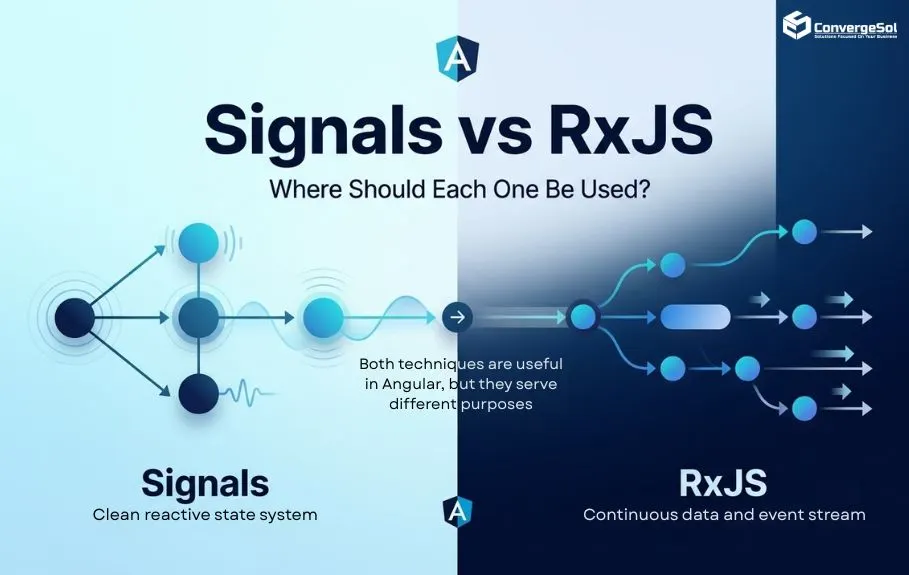
Signals vs RxJS in Angular: Where Should Each One Be Used?