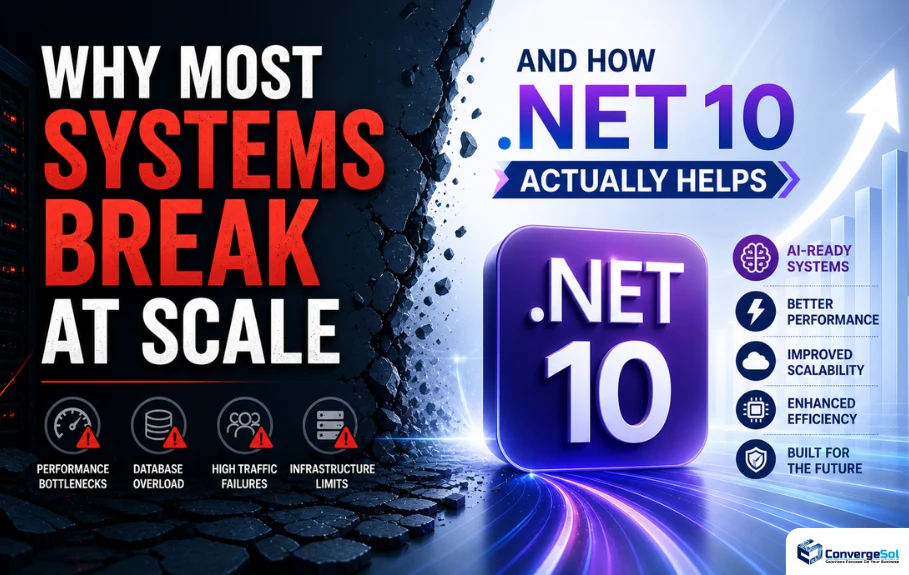
Why Most Systems Break at Scale And How Dot Net 10 Actually Helps
The Problem Isn’t Your Tech Stack
As companies grow, their systems don’t fail overnight—they degrade slowly.
It starts with:
- Slightly slower performance
- Small delays in processing data
- Minor inefficiencies in workflows
And over time, it turns into:
- Rising infrastructure costs
- Slower product releases
- Teams spending more time fixing than building
Most companies respond the same way:
“We need better technology.”
But the reality is:
The problem is rarely the tools. It’s how the system is designed.
Why Frameworks Like .NET 10 Are Getting Attention
Recent advancements from Microsoft—including .NET 10—are gaining significant attention.
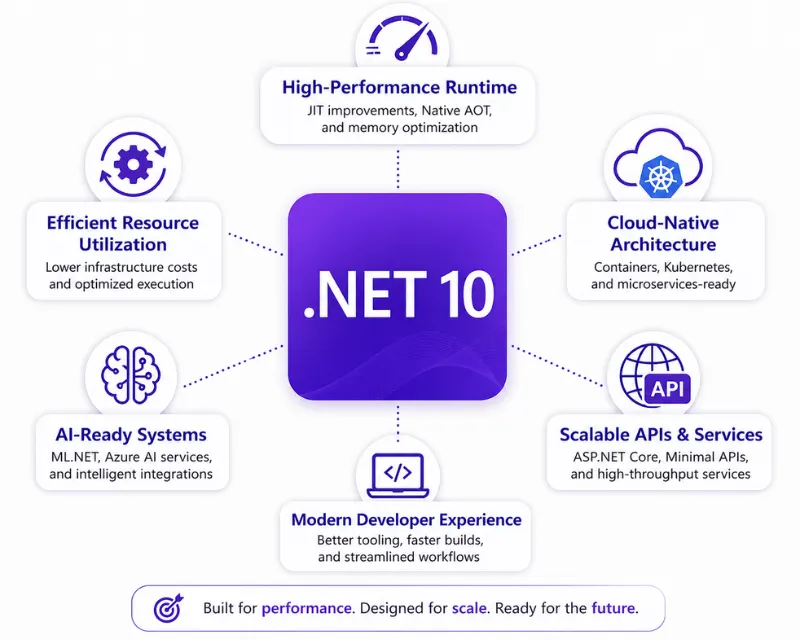
They offer improvements such as:
- Enhanced performance and runtime efficiency
- Optimized memory management
- Faster data processing capabilities
- Improved support for cloud-native and distributed architectures
- Seamless integration with AI-driven applications
You can explore the official .NET 10 performance and runtime improvements in Microsoft’s documentation: https://learn.microsoft.com/en-us/dotnet/core/whats-new/dotnet-10/overview
These capabilities provide a strong foundation for building scalable systems.
Where Most Companies Get It Wrong
Adopting a newer framework—even something as advanced as .NET 10—does not automatically resolve:
- Inefficient workflows
- Fragmented data pipelines
- Poor architectural decisions
- Manual, redundant operational processes
Many teams:
- Upgrade their tech stack
- Increase infrastructure spending
- Expand engineering teams
…and still face the same bottlenecks.
Because:
Modern frameworks like .NET 10 improve performance—but they cannot compensate for inefficient system design. It does not fix fundamentally broken ones
When workflows, data pipelines, and architecture are not aligned, scaling issues persist regardless of the technology used.
What Actually Drives Performance and Scale
Sustainable improvements come from fixing core system foundations:
- System Architecture
Designing systems that scale with growth—not against it - Data Pipelines
Ensuring clean, structured, and efficient data flow - Workflow Automation
Eliminating manual dependencies that slow operations - Infrastructure Optimization
Using resources efficiently to control cost and performance
Where .NET 10 Actually Adds Value
When implemented within a well-structured system, .NET 10 can significantly enhance:
- Application performance → Faster response times
- Resource efficiency → Lower infrastructure costs
- Data processing → Better handling of high-volume workloads
- AI readiness → Easier integration with intelligent systems
However, Its impact depends entirely on the underlying system design
A Practical Scenario
Consider a growing company managing high volumes of data and complex workflows.
They begin experiencing:
- Slow backend performance
- Increasing cloud costs
- Operational inefficiencies
Instead of only upgrading technology, real improvement comes from:
- Restructuring workflows
- Optimizing data pipelines
- Redesigning system architecture
- Then leveraging frameworks like .NET 10
The result:
- Faster systems
- Lower costs
- Improved scalability
How We Approach This at ConvergeSol
At ConvergeSol, we do not approach scaling problems as purely technical challenges—we treat them as system design and operational efficiency problems.
Our approach is structured into clear phases:
1. System Assessment & Bottleneck Identification
We begin by analyzing:
- Existing architecture (monolith vs distributed)
- Data flow across systems
- API performance and dependencies
- Workflow inefficiencies
Outcome: A clear map of where performance and cost issues originate
2. Architecture Redesign for Scalability
We restructure systems based on:
- Modular or microservices architecture (where required)
- Load distribution and scaling strategies
- API optimization and service separation
Outcome: Systems that scale predictably under growth
3. Data Pipeline Optimization
We fix:
- Redundant data movement
- Inefficient queries and processing
- Fragmented data sources
We implement:
- Streamlined pipelines
- Efficient data handling mechanisms
- Better storage and retrieval strategies
Outcome: Faster data processing and reduced system strain
4. Workflow Automation
Most scaling issues are caused by hidden manual processes.
We:
- Identify repetitive operational tasks
- Automate backend workflows
- Integrate systems for seamless data flow
Outcome: Reduced manual effort + improved operational efficiency
5. Infrastructure & Cost Optimization
We optimize:
- Cloud usage and resource allocation
- Compute and storage efficiency
- Deployment pipelines
Outcome: Lower infrastructure costs without compromising performance
6. Implementation with Modern Stack (Including .NET 10)
Only after fixing the system foundation do we:
- Implement or migrate to modern frameworks like .NET 10
- Optimize runtime performance
- Enable AI and advanced integrations
Outcome: Technology that actually delivers measurable impact
Let's Get Connect: https://convergesolution.com/contact
Business Impact We Typically Deliver
- In recent projects, we’ve helped teams significantly reduce infrastructure overhead—often in the range of 30–40%—by optimizing system design and data workflows.
- Reduced development bottlenecks by streamlining workflows and improving deployment processes .
- Improved system stability and response times during peak usage by optimizing backend performance.
- Built system architecture that can handle increasing workloads without requiring frequent rework.
Conclusion
Modern frameworks like .NET 10 are powerful.
But they are not a shortcut.
The companies that scale successfully build better systems—not just adopt better tools.
Why Choose ConvergeSol?
- Faster Time to Market: Our streamlined development process, honed over 14 years, can launch your software 3-6 months faster compared to traditional approaches.
- Seamless Communication & Control: Dedicated project managers and a proven methodology ensure clear communication and control throughout the entire development lifecycle.
- Cost-Effective Expertise: Benefit from our onshore and hybrid development solutions in the USA and India to access high-quality services at competitive rates.
- Deep Industry Knowledge: We understand the specific challenges faced by Finance, Health, Real Estate, Insurance, and Non-Profits. We develop effective solutions tailored to your business needs..
- Trusted Technology Partnerships: Our strong partnerships with industry leaders like Microsoft empower us to develop secure, scalable software solutions that leverage cutting-edge technologies and integrate seamlessly with your existing infrastructure.
Write your comment
Recent Blogs