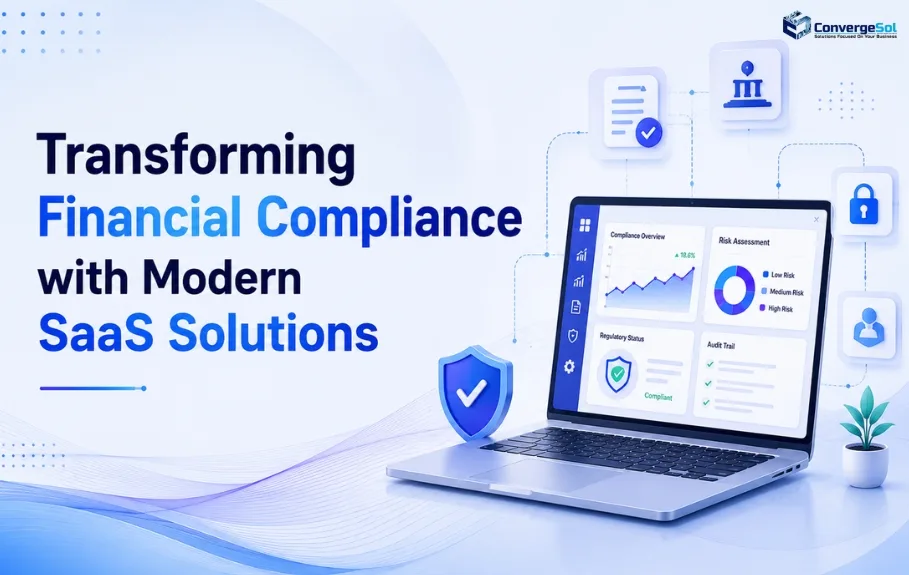
Transforming Financial Compliance with Modern SaaS Solutions
Introduction: Compliance Is No Longer Just a Regulatory Requirement
In today's highly regulated financial ecosystem, compliance has evolved far beyond simply satisfying auditors and regulatory bodies. It has become a strategic business capability that directly impacts operational efficiency, customer trust, scalability, and long-term growth.
Financial institutions, investment firms, hedge funds, and legal organizations face an increasingly complex regulatory landscape. Every trade, transaction, document, approval, and communication must be accurately tracked, monitored, and reported. Traditional spreadsheets, manual approvals, disconnected systems, and outdated software simply cannot keep pace with today's compliance demands.
This is where modern SaaS Product Development combined with Custom Software Development creates measurable business value.
Organizations are increasingly investing in intelligent compliance management platforms that automate workflows, integrate with financial ecosystems, and provide real-time visibility into regulatory operations. The result is faster decision-making, reduced operational risk, improved governance, and significantly lower compliance costs.
One real-world example demonstrates how the right technology partner transformed a struggling compliance initiative into a scalable enterprise platform serving thousands of users while dramatically reducing time-to-market.
Key Takeaways
- Modern SaaS solutions automate financial compliance workflows, reducing manual effort, operational costs, and regulatory risks.
- AI-powered compliance platforms enable real-time risk detection, transaction monitoring, and faster regulatory reporting.
- Custom software development helps financial organizations build compliance solutions tailored to their unique business processes and regulatory requirements.
- Cloud-native SaaS platforms provide scalability, security, and flexibility to support enterprise growth and evolving compliance needs.
- Integrating compliance systems with broker feeds, CRM platforms, and enterprise applications improves data accuracy and operational efficiency.
- Centralized audit trails, document management, and automated workflows strengthen governance and simplify regulatory compliance.
- Investing in intelligent SaaS compliance solutions enables financial institutions to improve governance, accelerate digital transformation, and stay ahead of changing regulations.
The Growing Complexity of Financial Compliance
The financial services industry operates under continuous regulatory pressure. Organizations must comply with numerous requirements involving:
- Insider trading surveillance
- Trade approvals
- Employee holdings monitoring
- Conflict of interest management
- Gifts and entertainment policies
- Watchlists and restricted securities
- Audit trails
- Document retention
- Regulatory reporting
The challenge is not simply collecting information.
The real challenge lies in connecting people, processes, data sources, and regulatory controls into one unified platform.
Without automation, compliance teams spend excessive time on administrative work instead of managing risk.
For executives, this creates several business concerns:
- Higher operational costs
- Increased compliance risk
- Slow approval cycles
- Limited reporting visibility
- Poor user adoption
- Difficult scalability
These problems become even more significant as organizations grow across multiple offices, jurisdictions, and regulatory environments.
When Traditional Software Becomes the Bottleneck
Many organizations initially attempt to solve compliance challenges using off-the-shelf applications or by extending legacy systems.
Unfortunately, these solutions often introduce new problems:
- Lengthy implementation cycles
- Expensive customization
- Difficult integrations
- Poor user experience
- Limited scalability
- Vendor dependency
- High maintenance costs
A financial services client experienced exactly this situation.
After spending nearly two years with another software development vendor, the organization still could not successfully launch its compliance platform. Development delays, growing costs, and limited financial domain expertise prevented the product from meeting business expectations.
Rather than continuing with incremental improvements, the organization adopted a completely different approach focused on domain expertise, agile execution, and scalable architecture.
Building a Modern Compliance SaaS Platform
Instead of rebuilding everything from scratch, the solution leveraged an enterprise-grade eDiscovery platform while delivering a customized compliance layer specifically designed for financial services.
Using a strategic SaaS Product Development approach, the platform included capabilities such as:
- Automated Trade Request Management:
Employees can submit trade requests through standardized workflows while compliance officers receive automated approval routing, notifications, and complete audit history. - Insider Trading Surveillance:
Continuous monitoring enables proactive identification of suspicious trading activities while maintaining detailed records of employee holdings and sensitive personnel information. - Broker Feed Integration:
The platform integrates with more than twenty leading financial institutions including UBS, Goldman Sachs, Citi, Fidelity, and Schwab, eliminating manual data entry and improving data accuracy. - Centralized Document Management:
Compliance documentation—including restricted lists, watchlists, conflict-of-interest disclosures, and policy documents—is securely managed within a single repository with role-based access controls. - Advanced Reporting:
Executives and compliance officers gain immediate access to dashboards, audit reports, compliance metrics, and historical activity logs that support faster regulatory reporting.
Why Custom Software Development Delivers Better Long-Term Value
Compliance processes vary significantly between organizations.
Every investment firm has unique approval hierarchies.
Every legal advisor follows different review workflows.
Every regulator introduces new reporting requirements.
This is why Custom Software Development offers substantial advantages over generic compliance applications.
A tailored solution allows organizations to:
- Build workflows around existing business processes
- Integrate with internal systems
- Automate repetitive compliance tasks
- Adapt quickly to regulatory changes
- Improve employee adoption
- Scale without major platform redesign
Instead of forcing the business to adapt to software limitations, custom solutions allow software to support evolving business strategies.
The Importance of Scalable Platform Engineering
Successful compliance platforms must support continuous business growth.
The platform discussed in this case study successfully evolved from supporting a small group of users to serving thousands of users without disrupting operations. It also underwent multiple technology upgrades—from Relativity v7.4 to v9.1, v9.4, and ultimately RelativityOne—while maintaining business continuity through disciplined release management.
Scalable engineering provides several long-term advantages:
- Higher system reliability
- Easier maintenance
- Lower infrastructure costs
- Faster feature delivery
- Improved security
- Reduced technical debt
For SaaS businesses, scalability is not simply a technical requirement—it is a competitive advantage.
AI Is Redefining Enterprise Compliance
Regulatory expectations continue to increase, making manual compliance processes increasingly unsustainable.
Modern AI Solutions for Enterprises are transforming compliance management through intelligent automation.
Leading organizations are beginning to leverage AI to:
- Detect suspicious behavioral patterns
- Identify compliance anomalies
- Predict regulatory risks
- Classify documents automatically
- Summarize audit findings
- Recommend policy actions
- Accelerate investigation workflows
- Generate executive compliance insights
Rather than replacing compliance professionals, AI enables them to focus on strategic decision-making while automation handles repetitive operational work.
As an experienced AI Solution Provider, technology partners can help organizations implement AI responsibly while maintaining regulatory transparency and governance.
The Role of Salesforce Consulting Services in Compliance Ecosystems
Compliance rarely operates in isolation.
Sales teams, customer onboarding, service operations, and finance departments all contribute to regulatory processes.
This is where Salesforce Consulting Services create additional business value.
Integrating Salesforce with compliance platforms enables organizations to:
- Automate customer onboarding
- Validate regulatory requirements
- Trigger approval workflows
- Centralize customer communications
- Improve document management
- Maintain complete customer audit histories
When Salesforce, compliance systems, and enterprise applications work together, organizations gain a unified view of customer relationships while reducing manual effort and compliance gaps.
Strategic Recommendations for Financial Organizations
Organizations planning digital compliance transformation should consider the following best practices:
- Prioritize business processes before technology. Clearly map compliance workflows before selecting a platform.
- Invest in scalable architecture. Regulatory requirements will continue to evolve, and the platform must evolve with them.
- Choose domain expertise. Financial services require specialized knowledge that general software vendors may lack.
- Automate wherever possible. Manual approvals and spreadsheets increase operational risk and reduce productivity.
- Leverage AI responsibly. Intelligent automation should enhance human decision-making, not replace governance.
- Integrate enterprise systems. Compliance platforms should seamlessly connect with CRM, ERP, document management, broker feeds, and reporting tools.
Looking Ahead: The Future of Compliance Management
Over the next five years, compliance platforms will become significantly more intelligent.
Organizations can expect broader adoption of:
- AI-powered compliance assistants
- Predictive risk analytics
- Continuous monitoring
- Real-time regulatory reporting
- Intelligent document processing
- Low-code workflow automation
- Cloud-native compliance platforms
- Integrated cybersecurity and compliance operations
Regulatory technology (RegTech) will increasingly shift from reactive reporting toward proactive risk prevention.
Businesses that invest early in digital compliance transformation will achieve stronger governance, faster innovation, and greater customer confidence.
Frequently Asked Questions
Q1. What is financial compliance software?
Financial compliance software helps financial institutions automate regulatory processes, monitor transactions, manage approvals, maintain audit trails, and generate reports to meet industry regulations while reducing operational risks.
Q2. Why are SaaS solutions ideal for financial compliance?
SaaS-based compliance solutions provide scalability, automatic updates, cloud accessibility, stronger security, and seamless integration with enterprise systems. They also reduce infrastructure costs and enable organizations to quickly adapt to changing regulations.
Q3. How does AI improve financial compliance management?
AI enhances compliance by detecting unusual activities, identifying potential regulatory risks, automating document classification, monitoring transactions in real time, generating compliance insights, and reducing manual workloads for compliance teams.
Q4. What are the benefits of custom financial compliance software?
Custom financial compliance software enables organizations to build workflows tailored to their business processes, integrate with internal systems, automate repetitive tasks, improve reporting accuracy, and scale efficiently as regulatory requirements evolve.
Q5. How can SaaS compliance platforms reduce operational risks?
Modern SaaS platforms minimize human errors by automating approvals, maintaining complete audit trails, providing centralized document management, enabling continuous monitoring, and delivering real-time compliance reporting.
Q6. Which industries benefit from compliance management software?
Compliance management software is widely used by banks, investment firms, hedge funds, insurance companies, asset managers, legal organizations, fintech companies, and other highly regulated industries that require strict governance and regulatory reporting.
Q7. What features should a modern financial compliance platform include?
A modern financial compliance platform should include automated workflows, AI-powered risk detection, trade monitoring, audit trails, document management, regulatory reporting, role-based access controls, broker integrations, and cloud scalability.
Q8. How does custom SaaS development support regulatory compliance?
Custom SaaS development allows organizations to design compliance solutions around their unique regulatory requirements, integrate with existing business systems, automate complex processes, and continuously adapt to new compliance standards without major system redesigns.
Conclusion
Compliance should never be viewed as a business constraint. When supported by modern technology, it becomes a strategic enabler for growth, operational excellence, and competitive differentiation.
The success of the compliance management platform discussed in this article demonstrates how the right combination of Custom Software Development, SaaS Product Development, financial domain expertise, and disciplined engineering can dramatically accelerate product delivery while creating a scalable solution capable of supporting enterprise growth. By replacing lengthy development cycles, manual processes, and fragmented systems with an integrated SaaS platform, the organization achieved faster time-to-market, improved operational efficiency, enhanced reporting, stronger security, and long-term scalability.
As regulatory complexity continues to rise, organizations that embrace intelligent automation, scalable cloud architecture, Salesforce Consulting Services, and AI Solutions for Enterprises will be better positioned to navigate change with confidence.
Partnering with an experienced AI Solution Provider and Fintech Software Development company enables businesses not only to meet today's compliance requirements but also to build future-ready digital platforms that drive innovation, resilience, and sustainable growth.
Write your comment
Recent Blogs
Why ASP.NET Core API is Slow: 10 Performance Bottlenecks and How to Fix Them