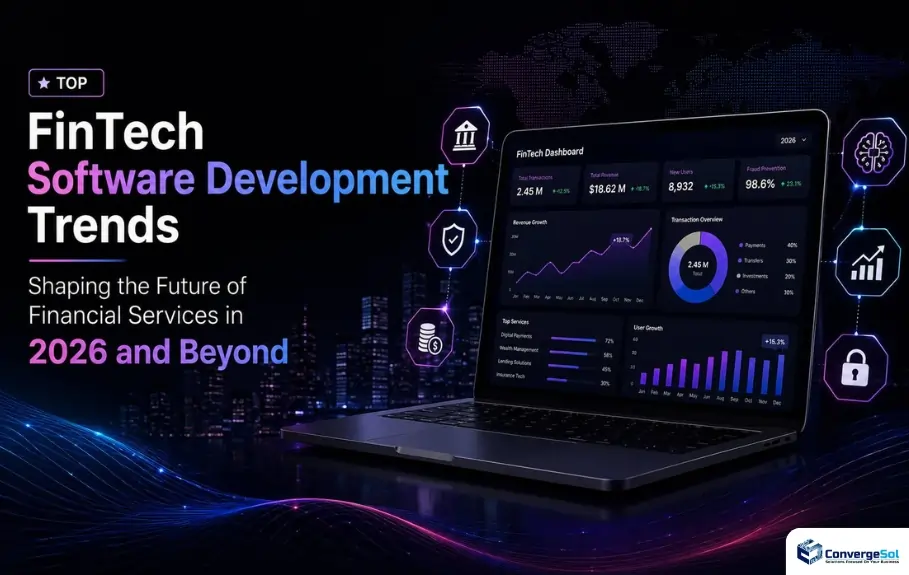
Top FinTech Software Development Trends Shaping the Future of Financial Services in 2026 and Beyond
The Financial Services Industry Is Entering a New Era
Financial services organizations are facing unprecedented pressure to modernize. Customer expectations continue to rise, regulatory requirements are becoming more complex, and emerging technologies are redefining how financial products are built, delivered, and managed.
From AI-powered compliance monitoring to embedded finance ecosystems, financial institutions can no longer rely on legacy systems and manual processes to remain competitive. Organizations that invest in innovation today will be best positioned to capture market share, improve operational efficiency, and deliver superior customer experiences tomorrow.
At ConvergeSol, we partner with banks, fintech companies, lenders, insurers, and wealth management firms through our specialized Financial Services industry expertise to accelerate digital transformation through Custom Software Development, Fintech Software Development, SaaS Product Development, Salesforce Consulting Services, and AI Solutions for Enterprises.
This article explores the most impactful trends transforming financial services and outlines the strategic actions organizations should take to stay ahead.
1. AI-Driven Compliance: Transforming Risk Management from Reactive to Predictive
Compliance has traditionally been viewed as a cost center. However, advancements in Artificial Intelligence are transforming compliance into a strategic business advantage.
Financial institutions process millions of transactions daily, making manual reviews increasingly impractical. Modern AI-driven compliance platforms continuously analyze transactions, identify anomalies, detect suspicious activities, and generate real-time risk insights.
Why Executive Teams Are Investing in AI Compliance
Organizations implementing AI-powered compliance solutions are achieving:
- Faster fraud detection and prevention
- Reduced manual review efforts
- Improved regulatory reporting accuracy
- Lower false-positive rates
- Enhanced audit readiness
Strategic Recommendation
Financial institutions should prioritize AI investments that combine automation with explainable AI capabilities. Regulators increasingly expect transparency in decision-making, making explainability just as important as accuracy. Organizations can reference the NIST AI Risk Management Framework when developing governance and risk management strategies for enterprise AI initiatives.
As a trusted AI Solution Provider, ConvergeSol helps financial institutions build intelligent compliance ecosystems that balance innovation, transparency, and regulatory requirements. Organizations looking to expand beyond compliance can also explore our insights on enterprise AI solutions for financial institutions.
2. Digital Onboarding Is Becoming a Competitive Differentiator
Customer acquisition increasingly depends on the quality of the onboarding experience.
Today's consumers expect account opening processes to be completed within minutes, not days. Lengthy applications, manual document verification, and fragmented workflows directly impact conversion rates and customer satisfaction.
What Best-in-Class Digital Onboarding Looks Like
Leading financial institutions are implementing:
- Mobile-first onboarding journeys
- Automated document verification
- Intelligent form validation
- Real-time eligibility assessment
- Straight-through processing
- Risk-based exception handling
Real Business Impact
A regional lender modernizing its onboarding platform can significantly reduce application abandonment while accelerating customer activation and reducing operational costs.
Organizations investing in Custom Software Development for onboarding are creating seamless customer journeys that drive measurable business growth.
Executive Consideration
Customer onboarding should be viewed as a revenue optimization initiative, not merely a compliance process.
3. Embedded Finance Is Redefining Financial Distribution
The next generation of financial services will increasingly be delivered outside traditional banking channels.
Embedded finance allows organizations to integrate lending, payments, insurance, and investment services directly into digital products and customer experiences.
High-Growth Embedded Finance Use Cases
- Buy Now Pay Later (BNPL)
- Embedded insurance
- Payroll-linked financial products
- Working capital financing
- Integrated wealth management services
Why It Matters
For financial institutions, embedded finance creates new distribution opportunities.
For technology companies, it unlocks entirely new revenue streams.
For customers, it delivers financial services precisely when and where they are needed.
Organizations investing in SaaS Product Development are increasingly designing API-first platforms capable of supporting embedded finance ecosystems at scale.
Strategic Recommendation
Executives should evaluate how their products can become platforms and how their platforms can become ecosystems.
4. KYC Automation Is Driving Faster Growth and Stronger Compliance
Know Your Customer (KYC) processes remain essential for AML compliance and fraud prevention, but traditional approaches often create friction for both customers and compliance teams.
Automation is enabling financial institutions to improve speed, consistency, and accuracy simultaneously.
Modern KYC Capabilities Include
- AI-powered document recognition
- Biometric verification
- Liveness detection
- Automated sanctions screening
- Continuous customer monitoring
- Dynamic risk scoring
Business Benefits
Organizations implementing intelligent KYC workflows are reducing onboarding delays while strengthening compliance outcomes.
This creates a rare opportunity where customer experience and regulatory compliance improve together.
ConvergeSol's Fintech Software Development teams help organizations implement scalable KYC automation frameworks that support growth without increasing operational complexity.
5. Cloud Modernization Has Become a Strategic Necessity
Every major financial innovation—from AI compliance to embedded finance—depends on scalable cloud infrastructure. Organizations are increasingly adopting Cloud Solutions to improve agility, security, and scalability.
Legacy systems often limit innovation by increasing maintenance costs, slowing product releases, and restricting integration capabilities.
What Cloud Modernization Enables
- Elastic scalability
- Faster product innovation
- Improved cybersecurity
- Enhanced disaster recovery
- Accelerated integrations
- Reduced infrastructure overhead
Executive Perspective
Cloud modernization is no longer an IT initiative.
It is a business transformation initiative that directly impacts customer experience, operational agility, and competitive positioning.
Organizations leveraging AI Solutions for Enterprises increasingly rely on cloud-native architectures to support advanced analytics, machine learning, and intelligent automation.
6. Salesforce Is Evolving into a Strategic Financial Services Platform
Many financial institutions still view Salesforce primarily as a CRM. However, modern Salesforce Solutions enable organizations to streamline customer engagement, compliance, and workflow automation.
Key Benefits
- Unified customer view
- Automated compliance documentation
- Advisor productivity enhancements
- Intelligent recommendations
- AI-powered customer insights
Business Context
Financial institutions that unify client, operational, and compliance data gain a significant advantage in customer retention and revenue growth.
ConvergeSol's Salesforce Consulting Services team helps organizations maximize platform value through strategic implementation, customization, and integration.
#Future Trends Financial Leaders Should Watch
Beyond today's priorities, several emerging technologies will significantly influence the next phase of financial services transformation:
Generative AI for Financial Operations
AI assistants will automate research, customer support, compliance reviews, and operational workflows.
Hyper-Personalized Financial Products
Advanced analytics will enable institutions to deliver highly customized financial recommendations and services.
Open Banking Ecosystems
API-driven collaboration will continue expanding opportunities for innovation and partnership.
Autonomous Compliance Monitoring
AI systems will increasingly monitor, interpret, and adapt to regulatory changes with minimal human intervention.
Real-Time Financial Intelligence
Organizations will leverage predictive analytics to make faster, more informed business decisions.
Financial institutions that begin preparing for these trends today will be better positioned to lead tomorrow
#How ConvergeSol Helps Financial Institutions Accelerate Innovation
Successful transformation requires more than technology. It requires domain expertise, execution capability, and a clear strategic vision.
ConvergeSol helps financial institutions achieve measurable business outcomes through:
- Custom Software Development
- Fintech Software Development
- SaaS Product Development
- Salesforce Consulting Services
- AI Solutions for Enterprises
- Cloud Modernization Services
With 14+ years of experience delivering solutions for regulated industries, we help organizations modernize faster while maintaining compliance, security, and operational excellence.
Frequently Asked Questions
Q1. What are the biggest fintech software development trends in 2026?
AI-driven compliance, embedded finance, digital onboarding, cloud modernization, KYC automation, and AI-powered financial intelligence are among the most significant trends shaping the industry.
Q2. How is AI transforming financial services?
AI helps automate compliance monitoring, fraud detection, customer service, risk assessment, and operational workflows while improving decision-making speed and accuracy.
Q3. Why is cloud modernization important for financial institutions?
Cloud platforms improve scalability, security, resilience, integration capabilities, and innovation speed while reducing infrastructure overhead.
Q4. What is embedded finance?
Embedded finance allows financial products such as payments, lending, insurance, and investments to be integrated directly into non-financial platforms and applications.
#Conclusion: The Future Belongs to Financial Innovators
AI-driven compliance, digital onboarding, embedded finance, KYC automation, cloud modernization, and intelligent CRM platforms are no longer future possibilities—they are today's competitive necessities.
The question facing financial leaders is no longer whether to modernize.
The question is whether they can modernize fast enough to meet evolving customer expectations, regulatory requirements, and market demands.
Organizations that invest strategically in innovation today will define the next decade of financial services.
Partner with ConvergeSol to transform your vision into scalable, secure, and future-ready financial technology solutions. Explore How We Work or Hire Dedicated Developers to accelerate your digital transformation initiatives.
Write your comment
Recent Blogs