Signals vs RxJS in Angular: Where Should Each One Be Used?
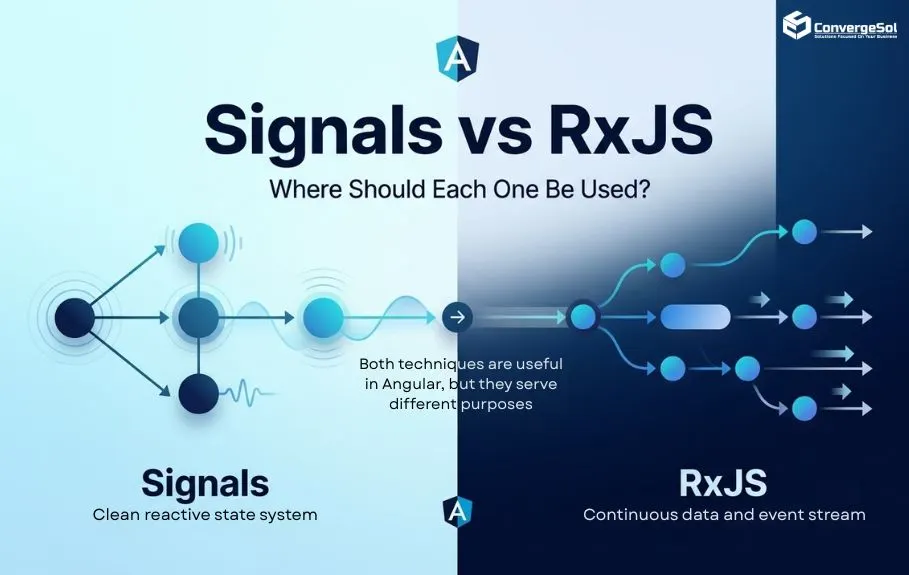
Angular Signals and RxJS are not competing replacements. They solve different problems. Signals are well suited to synchronous reactive state and component-level UI interactions, while RxJS remains valuable for asynchronous streams, event composition, cancellation, retries, and backend integrations. Tech leads and enterprise architects are actively weighing incoming RFCs against existing codebases. The central question: can this new paradigm streamline business-critical UI logic without undermining years of investment in resilient RxJS patterns?
Navigating the transition from RxJS to Signals isn't just about syntax—it is directly tied to predictable scaling, developer productivity, and long-term modernization. Some engineering leaders face board-level scrutiny and regulatory oversight that demand evidence against rushing into unproven toolchains. Others are under constant pressure to curb maintenance debt in aging applications while balancing compliance with innovation.
Rather than declaring a single "winner" for enterprise Angular, this article outlines clear operational boundaries for both tools. Where applicable, Angular Signals offer a streamlined way to rethink component state, optimize local rendering, and shorten onboarding cycles. However, when it comes to complex asynchronous streams, system reliability, and strict audit trails, RxJS remains the trusted backbone for enterprise software. Organizations planning large-scale application refactoring often partner with specialists in Product Development Solutions and Application Management Solutions to guide these architectural shifts.
Key Takeaways
- Use Angular Signals for local reactive state. Signals are well suited for tabs, filters, visibility, and other component-level UI state.
- Use RxJS for asynchronous streams. RxJS remains useful for API calls, polling, WebSockets, retries, cancellation, and event processing.
- Signals do not replace RxJS. Angular provides official interoperability through
toSignal()andtoObservable(). - Use a hybrid architecture for enterprise applications. Signals and RxJS can work together when UI state and asynchronous data flows have different responsibilities.
- Migrate incrementally. Modernize suitable components and avoid rewriting stable RxJS code simply because Signals are newer.
Angular Signals vs RxJS
| Area | Angular Signals | RxJS |
|---|---|---|
| Primary purpose | Reactive application state | Asynchronous/event streams |
| Best for | Local UI and component state | API calls, events, streams |
| Data model | Current value | Sequence of values over time |
| Typical operations | signal(), computed(), effect() | map(), switchMap(), debounceTime() |
| UI state | Excellent fit | Often unnecessary complexity |
| HTTP orchestration | Limited | Excellent fit |
| Polling | Not the primary strength | Excellent fit |
| Cancellation | Limited | Strong operator support |
| WebSockets | Not the primary strength | Excellent fit |
| Interop | toObservable() |
toSignal() |
Angular Signals vs RxJS: Core Differences
1. What Are Angular Signals?
Angular Signals introduce a declarative, synchronous model for managing component state. By enabling developers to declare reactive values and derived expressions, Signals give teams granular control over component rendering without the cognitive burden of managing manual subscription lifecycles or memory leak risks.
Angular Signals Code Example
The example below demonstrates how application state can be managed with Angular Signals. The paradigm uses the signal() method to declare reactive variables, on top of which derived values and side effects can be built:
TypeScript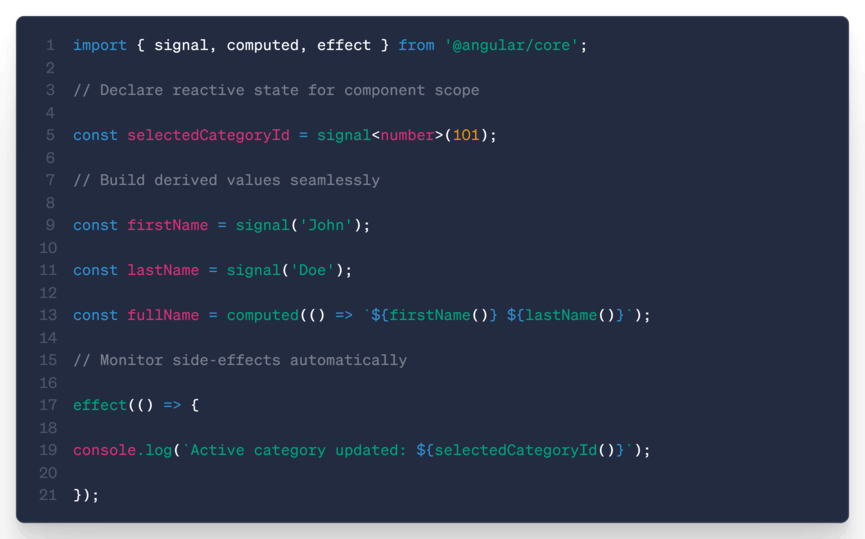
For enterprise applications such as financial dashboards, Signals can simplify local UI state management by making dependencies explicit and reducing the need for manual subscription handling. This can make component logic easier to reason about and test, particularly when the state is synchronous and component-bound.
2. What Is RxJS and Why Has It Dominated Angular?
RxJS has long served as the default reactive foundation for Angular applications, particularly for managing asynchronous HTTP request/response patterns. Its vast library of operators allows teams to build highly composable pipelines for complex event processing, WebSocket connections, and automated retry policies.
However, applying RxJS to simple local UI state often introduces unnecessary complexity. Managing unsubscribe patterns can lead to memory leaks if mishandled, and over-using complex operator chains can complicate debugging, performance auditing, and code reviews.
Use Cases & Performance Assessment
Signals and RxJS are not mutually exclusive; rather, they solve distinctly different problems within a modern enterprise stack.
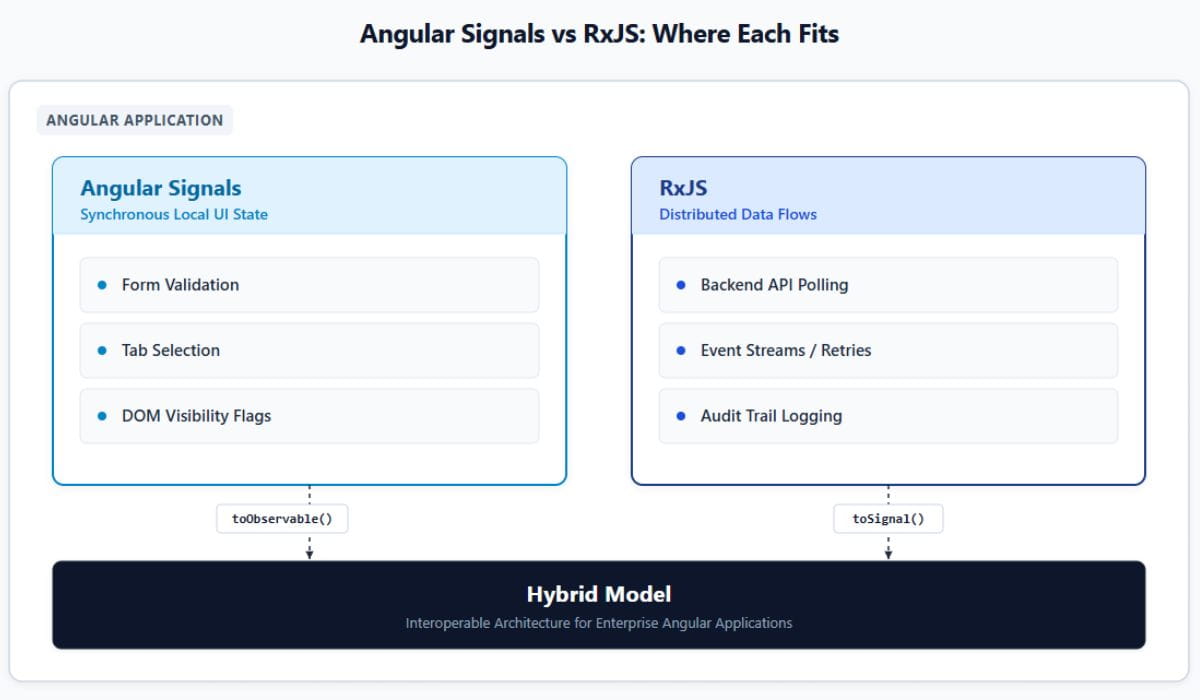
1. Signals: Component-Local UI Logic
Signals are ideal for fast, in-memory, synchronous interactions such as active tab selection, form validation toggles, or modal state.
TypeScript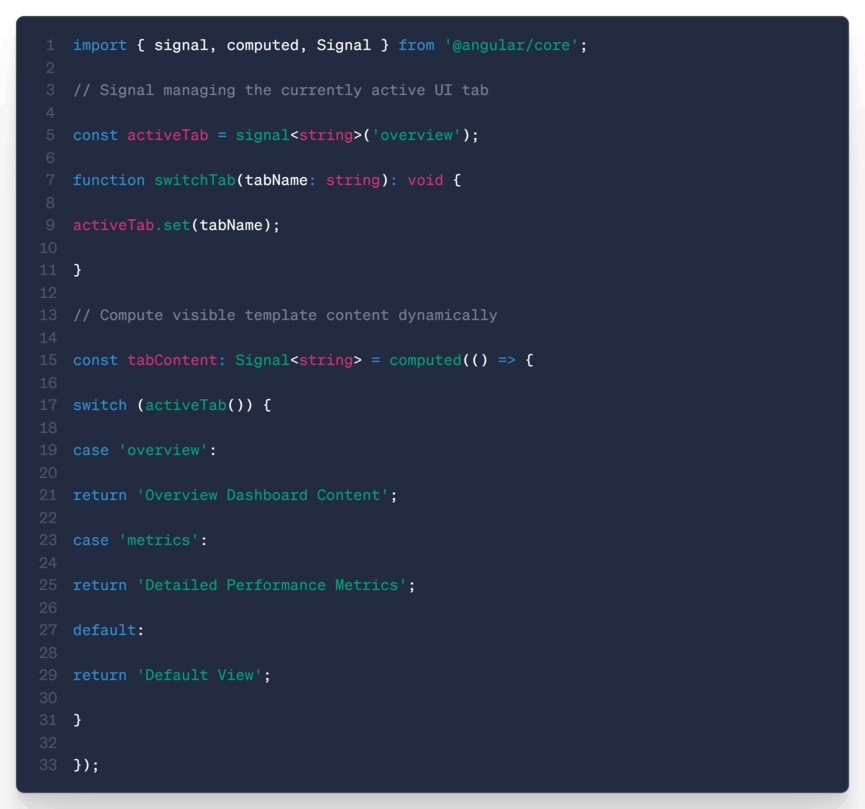
Performance: Signals allow Angular to track where reactive state is consumed and optimize rendering updates when that state changes.
2. RxJS: Distributed Data Flows & Remote Services
RxJS remains unmatched when coordinating distributed events, asynchronous HTTP requests, streaming backend updates, or resilient polling cycles.
TypeScrip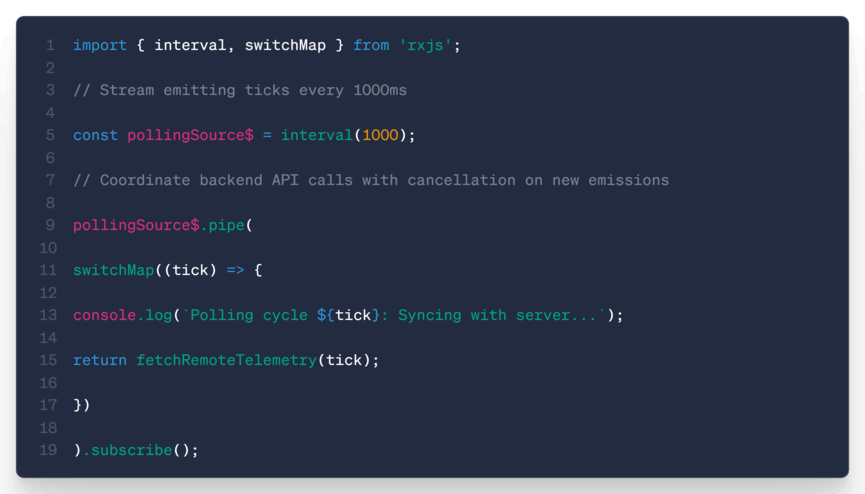
Performance: RxJS provides precise control over data streams before they hit the view layer, enabling teams to apply cancellation (switchMap), throttling (debounceTime), and error recovery without cluttering UI components.
Hybrid Approach: Combining Signals and RxJS
Most mature enterprise teams adopt a hybrid approach: leveraging RxJS for background service layers and streaming, while projecting those streams into Signals at the component boundary. Angular's official @angular/core/rxjs-interop utility package makes this bridge seamless through utilities like toSignal() and toObservable().
TypeScript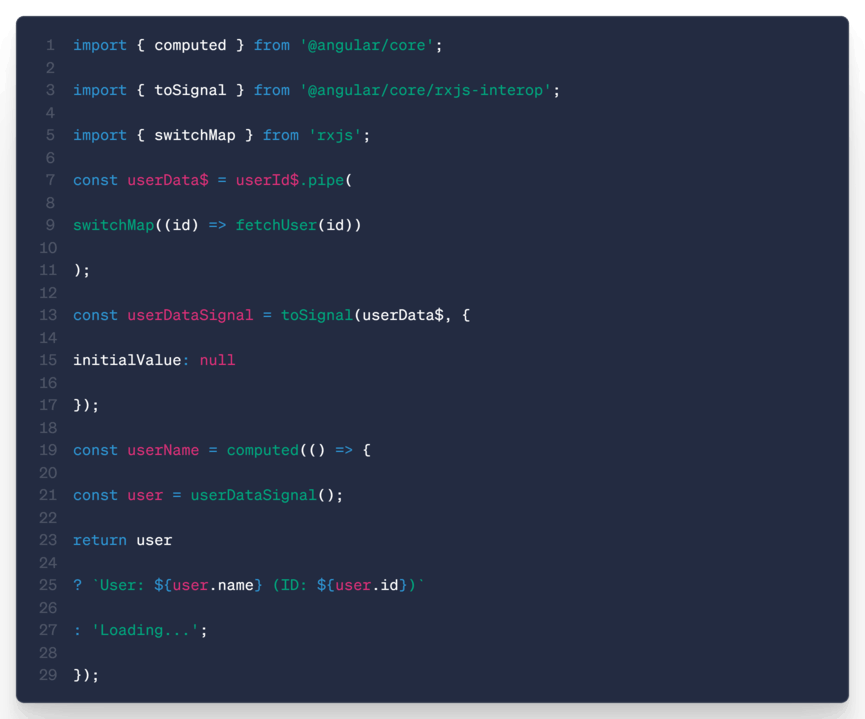
Architectural & Migration Considerations
When evaluating whether to adopt Signals or maintain RxJS patterns, technical leads and project managers should weigh key organizational and technical factors:
- Audit Data Locality: Evaluate existing code to identify components where Observables are used purely for local state. Target these isolated areas for immediate refactoring gains.
- Define Clear Governance: Establish team-wide standards with compliance leads detailing where RxJS is required for event auditability versus where Signals should handle UI updates.
- Plan Phased Rollouts: Avoid high-risk, all-at-once code rewrites. Introduce Signals incrementally in new feature modules while maintaining stable RxJS services in production.
- Prevent Pattern Drift: Enforce linting rules and code review policies to ensure developers don't mix paradigms arbitrarily within the same component layer.
For organizations looking to execute a seamless transition, reviewing real-world application architectures—such as this SaaS Platform Case Study—illustrates how .NET backends and modern Angular frontends scale effectively in production. Additionally, understanding How ConvergeSol Works as a single accountable partner provides clarity on managing complex technical rewrites with minimal delivery risk.
Enterprise applications rarely refactor frontend state management in isolation; changes are typically part of broader architecture modernizations. For engineering teams evaluating full-stack performance and tenant isolation, reviewing Best Practices for Building Multi-Tenant SaaS Platforms with .NET and Angular illustrates how Angular tenant routing, route guards, and Signal-based local state align with high-throughput .NET backends in production environments.
Frequently Asked Questions
When should Angular Signals replace RxJS in enterprise applications?
Signals are the best choice for synchronous, component-bound state such as tab navigation, modal visibility, or real-time UI filtering. RxJS should remain your go-to solution for distributed asynchronous streams, API polling, retry routines, and regulatory compliance logging.
What are the main operational risks of mixing Signals and RxJS?
Without clear architectural guidelines, mixing both tools can lead to duplicated state updates, confusing event flows, and higher onboarding costs for new hires. Using explicit conversion boundaries (toSignal and toObservable) alongside automated linting effectively mitigates these risks.
How do Signals improve application rendering performance?
Signals allow Angular to track where reactive state is consumed. When a Signal is read in a component template, Angular tracks that dependency and can mark the component for update when the Signal changes. This fine-grained dependency tracking can reduce unnecessary rendering work, particularly when combined with modern Angular change-detection strategies.
What is the recommended strategy for migrating a legacy RxJS codebase?
Start with a targeted audit to pinpoint components where Observables handle simple local state. Modernize these components in iterative sprints while keeping core asynchronous services on RxJS, ensuring your automated test suite is updated to capture edge cases.
How does adopting Signals affect component unit testing?
Signals simplify unit testing for local component logic because state transitions are synchronous and deterministic. Developers can set values and assert UI outputs directly without needing complex subscription mocks or asynchronous testing utilities.
Can Angular Signals and RxJS be used together?
Yes. Angular provides @angular/core/rxjs-interop, including toSignal() for exposing Observable values as Signals and toObservable() for exposing Signal values as Observables.
Conclusion
Angular Signals and RxJS are not competing technologies. They address different aspects of reactive application development, and the right choice depends on the type of state or data flow your application needs to manage.
Signals are a strong fit for reactive UI state, component interactions, derived values, and application state that needs to be consumed directly by the Angular view. RxJS remains valuable for asynchronous streams, HTTP orchestration, event processing, cancellation, retries, polling, and other complex data flows.
For enterprise Angular applications, the goal isn't to choose Signals over RxJS or RxJS over Signals. The better approach is to establish clear architectural boundaries: use Signals for reactive UI and application state, and use RxJS where asynchronous streams, cancellation, retries, event processing, or backend integration require it.
Teams modernizing existing Angular applications can also adopt a hybrid approach rather than rewriting everything at once. By using Angular's RxJS interoperability features, organizations can gradually introduce Signals while preserving proven RxJS patterns where they continue to provide value.
Looking for a US-Based Angular Development Partner?
Evaluating your Angular application architecture or planning a migration to modern reactive patterns? Let’s connect. Book a 15-minute consultation with ConvergeSol to discuss your technical roadmap, compliance needs, and development goals.
Write your comment
Recent Blogs
Why ASP.NET Core API is Slow: 10 Performance Bottlenecks and How to Fix Them