Angular SSR vs CSR vs SSG: Which Rendering Strategy Should You Choose?
In 2023, a global logistics company faced a challenge that many enterprises encounter as their digital platforms grow: its Angular application struggled to keep up with increasing user demand. The application relied heavily on client-side rendering (CSR), and the resulting performance issues affected the user experience, conversion opportunities, and confidence among regional business leaders. Search visibility and compliance requirements added further pressure to an already difficult situation.
Situations like this highlight why Angular rendering strategies are more than a technical decision. They influence how quickly users see content, how search engines discover pages, how infrastructure scales, and how teams manage security, compliance, and operating costs.
For CTOs, engineering leaders, and business stakeholders, the challenge is finding the right balance between performance, maintainability, and business requirements.
This guide explains the differences between Angular client-side rendering (CSR), server-side rendering (SSR), and static site generation (SSG). It explores when to use each approach, how they affect SEO and scalability, and what enterprise teams should consider before implementing or migrating to a new rendering architecture.
Rather than treating one approach as the universal answer, we’ll look at the practical trade-offs, implementation challenges, and governance decisions that determine whether an Angular application can scale reliably.
Key Takeaways
- CSR, SSR, and SSG serve different purposes. The right choice depends on interactivity, content freshness, SEO requirements, and operational constraints.
- SSR can improve initial content visibility and search engine accessibility, but it introduces server-side infrastructure, monitoring, and scaling requirements.
- SSG is well suited to stable, public-facing content. Frequently changing information may require regeneration, revalidation, or a different rendering approach.
- CSR remains effective for authenticated applications such as internal dashboards, employee portals, and interactive business tools.
- Hybrid Angular rendering combines multiple strategies but requires clear route ownership, consistent deployment processes, and well-defined security controls.
- Common migration challenges include browser-only APIs, hydration mismatches, authentication, caching, and analytics tracking.
- Successful enterprise implementations depend on more than framework capabilities. Testing, observability, governance, and cross-team collaboration are equally important.
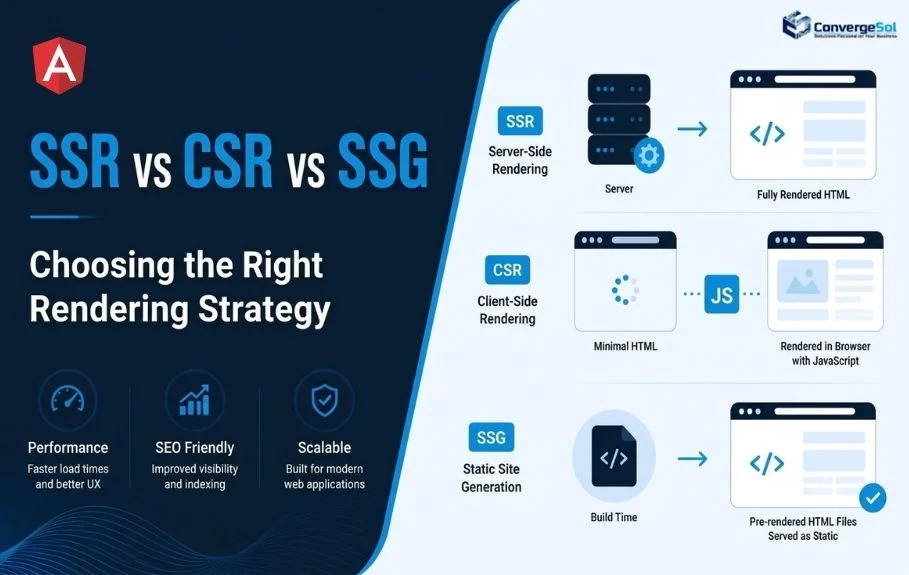
CSR vs SSR vs SSG in Angular: What Do They Mean?
Angular rendering determines when and where a page's HTML is generated. This affects initial content delivery, search engine discoverability, infrastructure requirements, and content freshness.
The three main approaches are client-side rendering (CSR), server-side rendering (SSR), and static site generation (SSG).
Client-Side Rendering (CSR)
With CSR, the browser loads the application's HTML and JavaScript, then executes the JavaScript to build the interface and retrieve the required data.
This approach supports highly interactive experiences, including authenticated dashboards, workforce management tools, and customer portals.
Initial content visibility depends on JavaScript execution, network conditions, and API response times. Although search engines can render JavaScript, teams should verify that important content is accessible and indexable.
Server-Side Rendering (SSR)
With SSR, Angular generates HTML on the server for an incoming request. The browser receives the rendered content, and Angular hydrates the page to enable client-side interactions.
This approach is useful for pages that require request-time data or benefit from delivering rendered HTML immediately. However, it also introduces server-side responsibilities, including capacity planning, response-time monitoring, error handling, and caching.
See Angular's server-side rendering documentation for implementation details.
Static Site Generation (SSG)
With SSG, Angular generates HTML ahead of time during the build or prerendering process. The resulting pages can be served through static hosting or a content delivery network (CDN).
This approach suits documentation, public resource libraries, and service pages whose content can be prepared before a visitor requests it.
The main consideration is content freshness. Teams need a publishing, regeneration, or revalidation process that ensures updates reach visitors within the required timeframe.
See Angular's prerendering guide for configuration details.
How Should Enterprises Choose?
Choose a rendering strategy based on each route's purpose, data requirements, and operational constraints. An enterprise application does not necessarily need the same rendering approach for every page.
| Route requirement | Recommended starting point | Key consideration |
|---|---|---|
| Authenticated interactive dashboard | CSR | Client-side performance and secure API access |
| Public page with request-dependent data | SSR | Server capacity, response time, and caching |
| Documentation or stable public content | SSG | Publishing frequency and content freshness |
| Application with mixed route requirements | Hybrid rendering | Clear route ownership and consistent security rules |
Use this table as a starting point rather than a fixed rule. Validate the selected strategy against actual route behavior, security requirements, content freshness, and measured performance before implementation.
Core Differences: Angular CSR vs SSR vs SSG
For enterprise teams, the practical differences between Angular rendering strategies extend beyond how HTML is generated. Each approach changes the way the application is deployed, monitored, maintained, and scaled.
| Consideration | CSR | SSR | SSG |
|---|---|---|---|
| HTML generation | In the browser | On the server per request | During the build or prerendering process |
| Initial content visibility | Depends on client-side execution | Rendered HTML can arrive with the response | Prerendered HTML is available immediately |
| SEO considerations | Requires attention to JavaScript rendering and indexing | Supports direct delivery of rendered content | Supports direct delivery of prerendered content |
| Infrastructure | Static assets and APIs; browser performs rendering | Requires server-side rendering capacity | Primarily static hosting and CDN delivery |
| Content freshness | Can retrieve current data through APIs | Can generate content using current request-time data | Depends on build and revalidation workflows |
| Interactivity | Well suited to rich client-side interactions | Supports interactivity after hydration | Supports interactivity when paired with client-side Angular code |
| Typical use cases | Authenticated dashboards and internal tools | Dynamic public pages and request-dependent experiences | Documentation, resource hubs, and stable content |
These are general characteristics rather than guarantees. Actual performance depends on application design, hosting, caching, JavaScript size, backend dependencies, and implementation quality.
CSR: Flexibility for interactive applications
CSR is often a practical choice for applications where users interact with complex interfaces, perform transactions, and access personalized information after authentication.
For example, a logistics company may use CSR for shipment management, dispatch operations, and employee dashboards. In these workflows, responsive interactions and reliable API communication are often more important than search engine visibility.
ConvergeSol’s interactive dashboard case study highlights our experience building enterprise applications with Angular, .NET Core, and SQL Server, including dynamic dashboards, reporting, and user management.
Rendering is only one part of frontend architecture. For another important design consideration, read our guide to Angular Signals vs. RxJS in enterprise applications.
However, if the same platform includes public shipment information, searchable service pages, or other discoverable content, a purely client-rendered approach may not meet every requirement.
The important question is whether CSR remains appropriate for every route as the application evolves.
SSR: Better initial visibility with additional operational needs
SSR can be useful when public content needs to be available in the initial HTML response. It can also support pages that require request-time data.
An e-commerce application, for example, might use SSR for product pages while retrieving inventory or pricing information from backend services.
The trade-off is that server-side rendering adds another component to operate. Traffic spikes, slow dependencies, server failures, and caching errors can affect response times and availability.
Teams should assess expected traffic, rendering latency, infrastructure costs, and recovery procedures before adopting SSR at scale.
SSG: Efficient delivery for content that changes predictably
SSG is a strong option for content that can be generated before users request it. Documentation portals, product literature, and public resource pages can benefit from fast CDN delivery and reduced request-time rendering work.
However, static generation requires a reliable publishing process. If a product disclosure, pricing detail, or legal notice changes, the team must ensure that the updated content reaches production within the required timeframe.
For regulated businesses, the process should include clear publishing ownership, validation, and a way to verify that updated content is available across the delivery infrastructure.
The key takeaway: CSR prioritizes client-side interaction, SSR generates content at request time, and SSG prepares content ahead of time. Enterprise architecture should account for these differences rather than assuming one approach will meet every requirement.
When to Use Each Strategy: Enterprise Angular Scenarios
Rendering decisions are most effective when they start with specific business requirements.
When CSR makes sense
CSR is well suited to internal tools, authenticated portals, and applications with extensive client-side interaction.
Consider a logistics organization that needs employees to manage shipments, review delivery statuses, and update operational records throughout the day. A client-rendered interface can support these workflows without requiring every interaction to generate a new server-rendered page.
CSR can also simplify the rendering infrastructure, although the application still needs reliable APIs, authentication, monitoring, and appropriate frontend performance controls.
Use CSR when:
- Most content is available only after authentication.
- Search engine discovery is not a primary requirement.
- Rich client-side interactions are central to the user experience.
- The team can manage JavaScript performance and API reliability effectively.
When SSR makes sense
SSR is worth considering for public-facing applications where initial content visibility and request-time data matter.
An e-commerce platform, for example, may benefit from SSR for product information, category pages, and other search-oriented experiences. A successful implementation can improve how quickly meaningful content becomes available, but SEO outcomes still depend on content quality, technical SEO, crawlability, and overall site performance.
SSR may also be appropriate for pages that require request-dependent content, provided sensitive information is handled correctly.
Use SSR when:
- Public pages depend on dynamic data.
- Initial content visibility is important.
- SEO and social sharing are significant considerations.
- The organization can support server monitoring, scaling, and incident response.
When SSG makes sense
SSG is a good fit for content that changes on a predictable schedule and does not need to be generated separately for every request.
A financial services company might use SSG for public product documentation, educational resources, and general policy information. Personalized account information or rapidly changing transaction data would require a different approach.
SSG can also support frequently updated content when the build and revalidation workflow is sufficiently reliable. The key is to match the publishing process to the required freshness of the information.
Use SSG when:
- Content can be generated before deployment or refreshed through a defined workflow.
- Low-latency delivery is a priority.
- CDN distribution can support the expected traffic.
- Content freshness requirements can be met through regeneration or revalidation.
Why hybrid rendering is often the practical choice
Large Angular applications rarely have identical requirements across every page.
A healthcare platform, for example, might use SSG for public educational resources, SSR for selected public or request-dependent pages, and CSR for authenticated dashboards containing patient-specific information.
This approach can balance discoverability, delivery performance, and interactive functionality. However, teams must define which routes use each strategy and ensure that authentication, caching, deployment, and content ownership remain consistent.
Hybrid rendering should follow clear architectural rules, not emerge from disconnected implementation decisions.
Example: Configure CSR, SSR, and SSG by Route
Angular supports hybrid rendering, allowing teams to select a rendering strategy for individual routes instead of applying the same approach to the entire application.
For example, an enterprise application might use CSR for an interactive dashboard, SSG for public documentation, and SSR for pages that require request-time data.

In this example:
- CSR (RenderMode.Client) renders the dashboard in the browser.
- SSG (RenderMode.Prerender) generates documentation HTML at build time.
- SSR (RenderMode.Server) renders product pages for incoming requests.
These route choices are illustrative. Before implementing them, confirm that each page's data requirements, authentication model, and deployment environment support the selected rendering mode.
See Angular's official hybrid rendering guide for configuration requirements and additional examples.
How Angular Rendering Affects SEO, Performance, and Scalability
Angular SSR, CSR, and SSG can all support performant applications. The difference lies in how they deliver content and what engineering work is required to maintain the desired results.
SEO and content discoverability
Search engines need to discover, crawl, and understand a page's content. SSR and SSG can provide meaningful HTML without requiring the initial page content to be assembled entirely in the browser.
This can simplify indexing and improve content accessibility for crawlers and other clients. Nevertheless, neither SSR nor SSG automatically improves rankings. Search engines still consider relevance, content quality, internal linking, page experience, canonicalization, and other technical SEO signals.
For Angular applications targeting competitive search terms, rendering should be evaluated alongside the rest of the SEO strategy.
Initial loading and user experience
Rendering affects how quickly users see meaningful content, but the rendering method alone does not determine performance.
SSR can deliver rendered HTML quickly, yet a slow server or backend dependency may delay the response. SSG can deliver prerendered pages efficiently, but large JavaScript bundles may still delay interactivity. CSR can provide excellent experiences when the application is optimized, although its initial content may depend on JavaScript execution.
Teams should measure real user performance rather than relying exclusively on local benchmarks.
Useful metrics include:
- Largest Contentful Paint (LCP): How quickly the main content becomes visible.
- Interaction to Next Paint (INP): How responsive the page feels to user interactions.
- Cumulative Layout Shift (CLS): How much the layout shifts unexpectedly.
Google's Core Web Vitals guidance explains these user-experience metrics.
Infrastructure and operating costs
CSR and SSG can reduce the need for request-time HTML rendering, while SSR adds server-side processing requirements.
However, total cost of ownership depends on more than the rendering method. API usage, CDN configuration, build pipelines, logging, monitoring, availability targets, and engineering maintenance all contribute to operating costs.
For example, an SSR implementation with appropriate caching and capacity planning may be more economical than an inefficient alternative. Likewise, an SSG implementation with unnecessarily frequent builds may introduce avoidable deployment costs.
Engineering and finance teams should assess cost alongside response times, traffic volume, and reliability requirements.
Scalability and resilience
SSG can handle large volumes of content requests efficiently because prerendered pages can be served through a CDN. CSR can scale effectively when its APIs and frontend delivery are designed for expected traffic. SSR can also scale, provided server capacity, concurrency, caching, and backend dependencies are managed appropriately.
The relevant question is not simply which approach scales best. It is which architecture can sustain the application's expected demand while meeting its performance, availability, security, and budget requirements.
For enterprise applications, these considerations should be reviewed together rather than treated as separate technical concerns.
Angular SSR and SSG Implementation: Common Pitfalls
Moving an existing Angular application from CSR to SSR or SSG requires more than changing configuration. Browser-dependent code, authentication, hydration, caching, and deployment workflows can all behave differently once rendering moves beyond the browser.
1. Browser-only APIs
Angular applications may rely on browser APIs such as window, document, and localStorage. These APIs are not generally available in the same way during server-side execution.
Code that works correctly in the browser may therefore fail during server rendering or prerendering.
Before migrating, teams should identify browser-dependent logic, isolate it where necessary, and test both server and browser execution paths.
2. Hydration mismatches
Hydration allows Angular to attach client-side functionality to HTML that has already been rendered on the server.
Problems can arise when the server-generated markup differs from what the browser expects. Differences in generated content, time-dependent values, DOM manipulation, or rendering conditions may cause hydration errors or unexpected behavior.
Testing should cover representative routes, dynamic data, interactive elements, and production-like conditions. Teams should also monitor hydration errors after deployment instead of relying exclusively on pre-release testing.
3. Authentication and personalized data
SSR introduces additional considerations when rendering content that depends on the current user.
The server must handle authentication context correctly, enforce authorization, and avoid exposing private data through shared caches. Session-dependent responses should not be treated as public content unless the data and caching behavior have been explicitly designed for that purpose.
For financial services and healthcare applications, these controls should be reviewed alongside existing security and compliance requirements.
4. Caching and content freshness
Caching can improve performance, but incorrect cache rules may serve outdated or user-specific information to the wrong audience.
SSG introduces a related challenge: generated content must be refreshed when its underlying information changes.
A reliable implementation defines cache policies, content invalidation procedures, regeneration triggers, and verification steps. For legal or compliance-related content, teams should also establish who approves changes and how publication deadlines are monitored.
5. Analytics and third-party integrations
Rendering changes can affect when analytics scripts execute, when events fire, and how third-party integrations initialize.
For example, an event that previously fired after a browser interaction may behave differently when the page is initially rendered on a server and subsequently hydrated.
Teams should verify analytics events, consent behavior, tag execution, and conversion tracking after migration. Otherwise, an application may appear to have changed in performance or conversion rate simply because measurement behavior has changed.
6. Route ownership and governance
In large Angular applications, rendering decisions can become difficult to maintain when no team owns individual routes or their content requirements.
Product teams may control content changes, engineering teams may manage rendering and deployment, and compliance teams may approve regulated information. Without clear responsibilities, changes can be delayed or released without the necessary checks.
A route inventory that records rendering strategy, business owner, data sensitivity, cache policy, and release requirements can make these responsibilities easier to manage.
Organizations reviewing these challenges may also benefit from structured application management solutions that support ongoing monitoring, maintenance, and release reliability.
Enterprise Decision-Making: Choosing the Right Angular Rendering Strategy
Selecting an Angular rendering strategy is both an architecture decision and an operational decision. Engineering teams need to understand the technical implications, while product, security, compliance, and operations teams must agree on the requirements that influence implementation.
A practical selection process should cover five areas.
1. Map routes to business requirements
Start by documenting the application's important routes and grouping them according to their purpose.
For each route, identify whether it is public or authenticated, how frequently its content changes, whether search visibility matters, and whether it contains sensitive information.
This provides a more reliable foundation for rendering decisions than applying one strategy across the entire application by default.
2. Define performance and availability targets
Set measurable expectations for initial loading, responsiveness, availability, and recovery.
These targets should reflect actual user needs and contractual obligations. A public marketing page and an authenticated transaction workflow may require different performance and availability controls.
3. Assess security and compliance requirements
Identify which routes contain sensitive data, which require approval before content changes, and which need specific audit records.
For financial services applications, rendering and caching decisions should align with data protection, security policies, and applicable compliance requirements. Learn more about our financial services technology solutions
4. Pilot the approach before migrating broadly
A phased migration allows teams to validate rendering behavior, infrastructure requirements, analytics, and operational readiness before expanding the implementation.
The pilot should include clear success criteria, rollback procedures, representative routes, and testing under realistic conditions.
5. Assign ownership and review results
Define who owns route selection, application code, infrastructure, content freshness, security controls, and incident response.
After deployment, review performance, errors, operating costs, search visibility, and conversion metrics. Use those findings to determine whether the architecture continues to meet business needs.
A successful rendering migration is one that meets its intended business requirements and remains manageable after launch.
Angular SSR, SSG, and CSR Architecture: Technical Patterns and Operational Risks
Angular's tooling makes it possible to introduce server rendering and prerendering, but production architecture still requires deliberate decisions about deployment, dependencies, and recovery.
CSR architecture
A typical CSR application serves frontend assets through a web server or CDN and retrieves application data through backend APIs.
This approach can simplify frontend deployment, but API reliability, client-side errors, JavaScript performance, and authentication still require careful management.
Teams should focus on code splitting, lazy loading, error handling, and reliable telemetry.
SSR architecture
An SSR application adds a server-side rendering layer that generates HTML for incoming requests.
Production readiness includes server health checks, capacity planning, timeout management, dependency monitoring, and fallback behavior. Teams should also establish how rendering failures are detected and how the application can be rolled back if a deployment introduces instability.
Where caching is appropriate, it should be designed around the page's data sensitivity and freshness requirements.
SSG architecture
An SSG application generates selected routes during the build process and distributes the output through static hosting or a CDN.
The build pipeline becomes an important part of the application's reliability. Teams need to manage build failures, validate generated pages, publish updates predictably, and ensure that critical content changes trigger the correct workflow.
For larger sites, the team should also assess build duration, route count, and the operational impact of frequent regeneration.
Shared architectural considerations
Regardless of the rendering strategy, enterprise Angular applications need consistent approaches to testing, security, monitoring, and deployment.
Third-party integrations, DOM-dependent functionality, API calls, analytics, and user context should be assessed for compatibility with the chosen rendering model.
Organizations working on broader architecture improvements can explore product development solutions and cloud solutions to understand how development practices and infrastructure design support application reliability.
Hybrid Angular Rendering: Managing Complexity Across Teams
Hybrid rendering allows different routes to use different rendering methods, but flexibility can introduce inconsistency if teams do not establish shared standards.
Consider an enterprise application with public marketing pages, dynamic customer experiences, and authenticated operational dashboards. Each area may have a valid reason to use a different rendering strategy.
The challenge is maintaining a coherent architecture as the application grows.
A practical governance model should clarify three responsibilities:
- Architecture and infrastructure: Engineering and DevOps teams define rendering boundaries, deployment standards, monitoring, and rollback procedures.
- Content and compliance: Product owners and relevant compliance stakeholders define content requirements, approval processes, and update deadlines.
- Operations and incident response: Support and operations teams follow documented procedures for diagnosing failures, escalating incidents, and restoring service.
Teams should also agree on common rules for authentication, cache behavior, analytics, error reporting, and route ownership.
Regular architecture reviews can help identify unnecessary complexity, outdated rendering decisions, and changes in business requirements. Reviews are particularly useful before major campaigns, significant application releases, or changes to compliance obligations.
Hybrid rendering works best when each route has a clear purpose, an accountable owner, and a documented operational model.
Frequently Asked Questions
What is the difference between Angular CSR, SSR, and SSG?
CSR renders the application in the browser, SSR generates HTML on the server for incoming requests, and SSG generates HTML ahead of time during the build or prerendering process. CSR suits interactive applications, SSR supports request-dependent rendering, and SSG is useful for content that can be generated before a request.
Which Angular rendering strategy is best for SEO?
SSR and SSG can make page content available in the initial HTML, which can simplify search engine discovery and indexing. However, neither guarantees higher rankings. Content quality, crawlability, metadata, internal links, performance, and the broader technical SEO implementation remain important.
When should an enterprise Angular application use SSG?
SSG is appropriate for public pages whose content can be generated ahead of time, such as documentation, resource centers, and service pages. Frequently changing content can also use SSG if the publishing process supports timely regeneration or revalidation.
What are the common challenges when migrating Angular CSR applications to SSR or SSG?
Common challenges include browser-only APIs, hydration mismatches, authentication handling, cache configuration, analytics compatibility, and changes to build and deployment processes. A successful migration includes route assessment, automated testing, monitoring, and clear ownership of operational responsibilities.
Can Angular use CSR, SSR, and SSG within the same application?
Yes. Angular supports hybrid rendering, allowing routes to use different rendering strategies based on their requirements. Teams should define route-level rules and ensure that security, caching, deployment, and content freshness remain consistent across the application.
Conclusion: Make Angular Rendering a Business-Aligned Architecture Decision
Choosing between Angular CSR, SSR, and SSG is not about following a single best practice. It is about understanding how rendering affects users, infrastructure, search visibility, security, and the teams responsible for maintaining the application.
CSR remains a strong option for interactive, authenticated experiences. SSR can support dynamic public-facing pages that benefit from server-generated HTML. SSG provides efficient delivery for content that can be generated ahead of time. Hybrid rendering brings these options together when different routes have different requirements.
The most effective approach starts with the application's actual needs. Map routes to business priorities, define performance and security requirements, test the architecture under realistic conditions, and establish clear ownership before scaling the implementation.
After launch, continue measuring the outcomes that matter: Core Web Vitals, server response times, error rates, operating costs, content freshness, and conversion performance.
For enterprise teams, rendering architecture should evolve alongside the product, not remain fixed simply because an initial implementation worked.
Looking for a US-Based Partner to Modernize Your Angular Application?
Choosing between SSR, CSR, and SSG for your enterprise application? ConvergeSol can help you evaluate the right rendering strategy for your performance, scalability, and business requirements. Book a 15-minute consultation with ConvergeSol to discuss your architecture and modernization goals.
Write your comment
Recent Blogs

Signals vs RxJS in Angular: Where Should Each One Be Used?